

And what your manufacturing company can learn from the frontrunners
Why do some manufacturers gain a competitive edge faster than others? It rarely happens as a result of a single spectacular technology, but rather by ensuring that processes, people, data, and investments evolve in tandem. Factories of the Future (FoFs) demonstrate that sustainable progress is achieved when individual choices reinforce one another and the entire organisation moves in the same direction.
Of the more than 100 participants in the Smart Manufacturing Barometer, ten companies hold the Factory of the Future label. What does their position tell us about the gap between the average manufacturer and the industry leaders? In what ways do these companies stand out, and what lessons can you learn from them for your own production environment?
The leading group performs better
Factories of the Future invest in technology, but their lead is most evident in their results. A separate analysis by Sirris, based on data from Belfirst, shows that both added value and labour productivity grew significantly faster among FoF award winners between 2015 and 2023 than in the manufacturing sector as a whole. Labour productivity grew by an average of 4.6% per year, compared with 2.7% for the sector.
Walter Auwers, Business Unit Manager Advanced Manufacturing at Sirris, does not see any single formula for success behind that difference. “We see three factors again and again at high-performing manufacturers: a deeply ingrained culture of operational excellence, a high level of digital maturity, and smart automation that goes beyond mere labour savings. It is above all the combination of these factors and the consistent approach maintained over several years that makes the difference.”
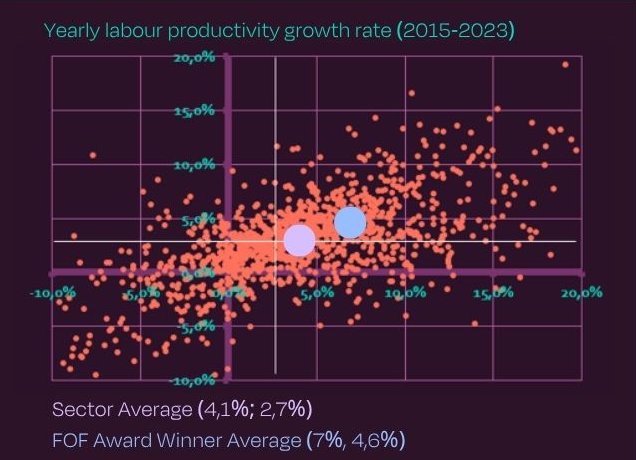
Source: Sirris analysis based on Belfirst data.
Technology is only effective if the foundations are in place
Digitalisation and automation can speed up processes, but they do not necessarily solve underlying problems. The Smart Manufacturing Barometer shows that many Flemish manufacturers are already focusing on building a solid operational foundation. Lean manufacturing, standardised work, shop floor meetings, and visual management play a prominent role in this.
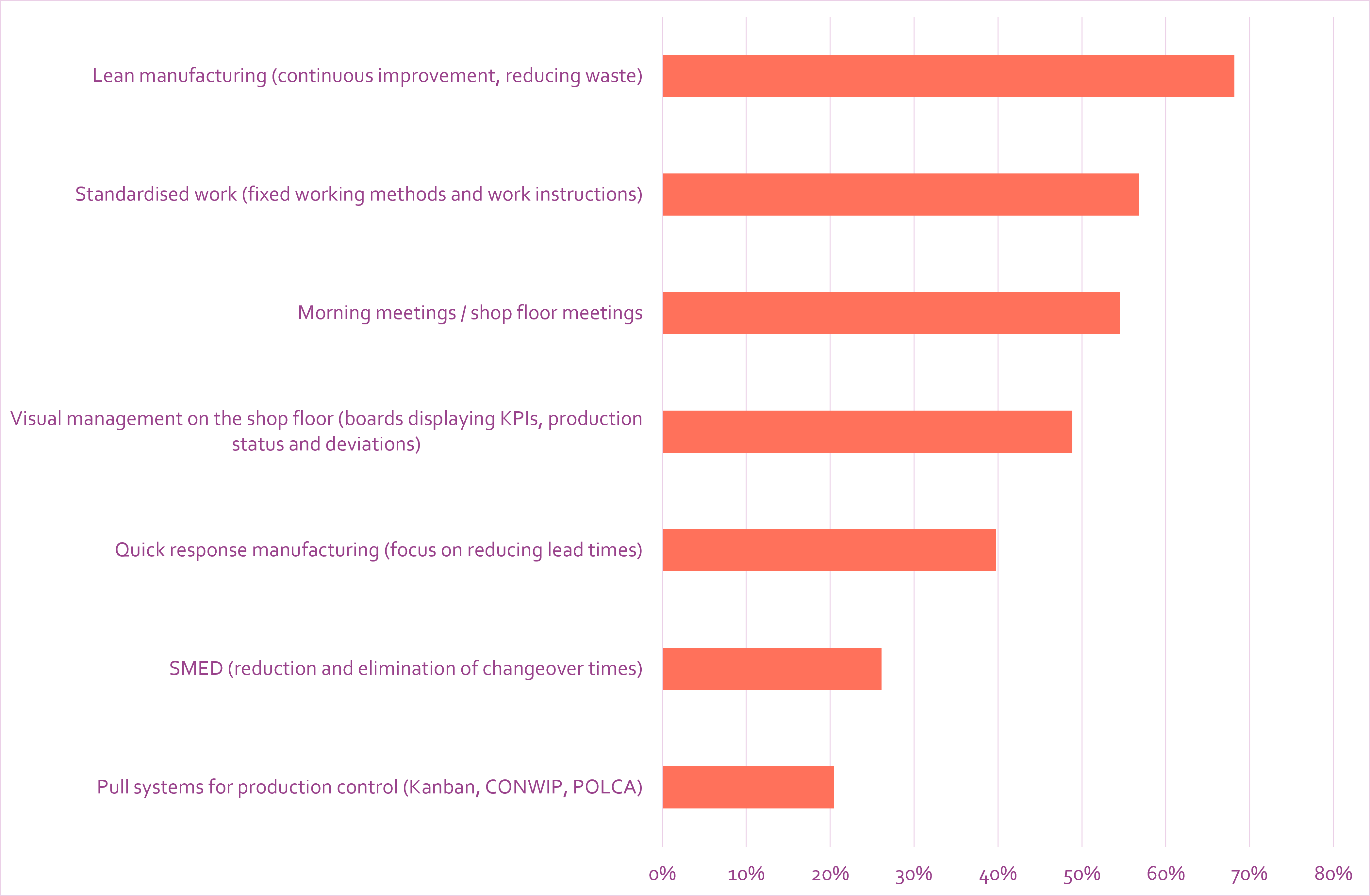
Application of production and improvement principles in Flemish manufacturing companies.
Source: Smart Manufacturing Barometer
These principles are not new, but they are as relevant as ever. Digitalisation will make a process that is not properly under control even more unpredictable. By contrast, clear working methods, visible performance, and continuous improvement make it easier to deploy new technology in a purposeful manner.
“Digitalisation and automation accelerate productivity growth, but they do not replace strong production foundations.”
Walter Auwers, Business Unit Manager Advanced Manufacturing at Sirris
For Factories of the Future, this foundation is not a separate improvement project: it forms part of day-to-day operations. These companies use technology to build on processes that they systematically monitor, evaluate, and refine. This creates scope to go beyond individual applications.
Connect before you invest any further
Flemish manufacturers are currently digitalising and automating at different rates. Traditional automation is widespread, but far fewer companies are opting for flexible solutions such as cobots and mobile robots. The level of maturity of digital production monitoring also varies considerably. Some companies are already connecting machines, systems, and dashboards; others are just starting out or only using a few applications.
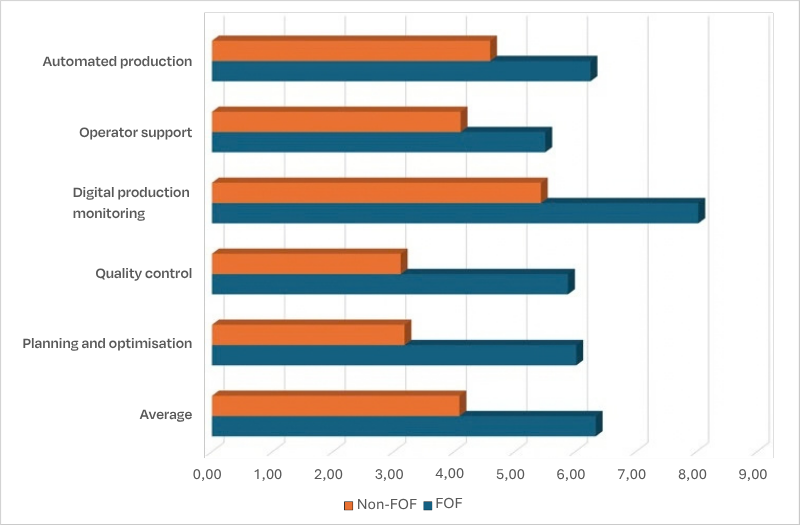
Additional FoF analysis. FoF: n=11; non-FoF: n=80.
Weighted maturity score out of 10; ‘not applicable/no plans’ excluded.
Source: Smart Manufacturing Barometer
The FoF companies are ahead of the other respondents in each of the five technology areas assessed. Digital production monitoring has come furthest in both groups. The biggest gap lies in planning and optimisation, and in quality control. It is precisely in these areas that companies use data not only to make processes transparent, but also to identify anomalies, support decision-making, and make targeted adjustments to performance.
A Factory of the Future does not have to be the first to adopt every new technology. It is the coherence between the choices that really makes the difference.
- A connected machine only delivers sufficient value if it generates reliable data and the production teams can use that data effectively to adjust production
- A robot only becomes a flexible production solution if the company also aligns its programming, planning, material supply, and skills accordingly.
This is why FoF companies look beyond simply purchasing a machine or application. They view every investment as part of a wider transformation of the production environment.
Make the Future: seven transformations, one shared direction
An industrial transformation lasting several years requires clear priorities and a shared framework. The Make the Future programme run by Sirris and Agoria therefore brings together seven areas:
- Advanced Manufacturing Technologies: using advanced manufacturing technology to boost productivity and enhance competitive advantage
- Digital Factory: connecting machines, processes, and systems to make better use of data
- Eco Factory: reducing energy and material use and closing loops
- Integrated Engineering: designing products and processes with the entire life cycle and value chain in mind
- Human Centered Organisation: giving employees greater autonomy and making active use of their knowledge
- Smart Manufacturing: developing flexible production systems that can adapt to variation and change
- Networked Factory: working more effectively with customers, suppliers, and other partners
Taken together, these areas illustrate why a Factory of the Future is more than just a highly digitalised factory. Product and process design, the use of energy and materials, collaboration with partners, and the role of employees also determine how future-proof a manufacturing company is.
Even the leading group continues to develop. “Integrated Engineering and Networked Factory, in particular, still require attention,” says Walter Auwers. “Closer links between engineering, production, the supply chain, and external partners help companies share knowledge more quickly, shorten development times, and bring innovations to market sooner.” The strategy and production context determine which step takes priority. Every decision must fit within the wider transformation process and reinforce the other areas.
Discover the Make the Future programme
Three questions to help you decide on your next step
Three specific questions will help you decide where your manufacturing organisation can create the most added value:
- Which processes and capabilities determine your competitive strength?
- Where is a lack of coherence slowing down the return on your investments?
- Which change offers your company the greatest strategic added value?
The answers will vary depending on the production environment. A company that primarily wants to increase its capacity faces different choices from one that wants to switch between variants more quickly. Existing systems, capabilities, and processes also affect which step is realistic.
Above all, Factories of the Future demonstrate the importance of a consistent approach. They combine a solid operational foundation with targeted investments and continue to adapt their organisation as technology and market conditions change.
Find out where your next growth opportunity lies
Factories of the Future do not offer a blueprint that any manufacturer can simply copy. The Smart Manufacturing Barometer shows how far the sector has come in terms of technology adoption, enabling you to compare your position with that of the manufacturing sector as a whole and refine your decisions.
Summary
Factories of the Future do not build their lead with a single technology. They combine robust processes with digitalisation, smart automation, and engaged employees. This coherence boosts their productivity and helps them invest in a purposeful manner. Find out which lessons you can apply in your own production environment.
Where does your manufacturing company stand today?

Factories of the Future show how robust processes, digitalisation, and smart automation reinforce one another. But how far has your own production organisation progressed? Download the Smart Manufacturing Barometer and compare your approach with those of other Flemish manufacturers. Discover where the sector stands today, which technologies companies are using, and where your organisation has opportunities to invest in a more purposeful manner.
Would you like to take things a step further?
Through Make the Future, Sirris and Agoria will assess your position within the seven transformation areas. An initial scan of your production organisation helps to identify growth opportunities and set priorities that align with your strategy.
Discover the other articles in this series
- Smart Manufacturing Barometer 2026
- Bespoke solutions make us strong, but they’re complex
- Four insights: how Flemish manufacturing companies are investing in smart production technology
- From fixed automation to flexible, smart manufacturing
- How to make your shop floor smarter through digitalisation
- The factory of tomorrow begins today: five choices that determine your competitive edge
- What Factories of the Future do differently ⬅ Current article
- P&V Panels automates intelligently in a setting of predominantly bespoke output


