

Flexible automation for smaller production runs
Automated production is well established in the Flemish manufacturing industry. It increases output, helps maintain consistent quality and makes processes more predictable. However, these benefits are greatest when products, tasks and circumstances are mainly fixed. That is precisely where the new challenge lies: how do you make automation flexible enough to cope with smaller batches and a greater number of variants? And what does that mean for the next stage of investment?
Three Sirris experts put this development into perspective, each from their own field of expertise: flexible robotisation, data-driven process automation and production connectivity.
From repetition to switching and adjusting
Traditional automation is designed for clearly defined processes and carries out fixed, repetitive tasks. This is why automated machines, production lines and industrial robots are the backbone of many manufacturing environments. Particularly with larger volumes, the costs and time involved in programming, integration and configuration are less of a factor, making the investment easier to justify. This goes a long way towards explaining why industrial robots continue to play a key role in the manufacturing industry.
The shift from mass production to smaller batches with greater variety is driving a move towards flexible automation. Cobots and robots must be able to switch between different, but pre-programmed, tasks and workstations. This places greater demands on programming, changeover and integration. That is why it only really works when a company understands its processes and data well enough to define these scenarios reliably.
Smart automation goes another step further. It's not about the number of robots, but about their flexibility. How easily can they switch between products, tasks, workstations and circumstances? The system responds autonomously to changing situations and optimises the way it operates on the basis of data. The process therefore progresses from repetition, through switching to adjusting.
How far a company can go with automation therefore depends not only on new hardware, but also on its digital maturity. Are data merely collected, or are they also actively used to make systems self-learning?
What makes robotisation flexible?
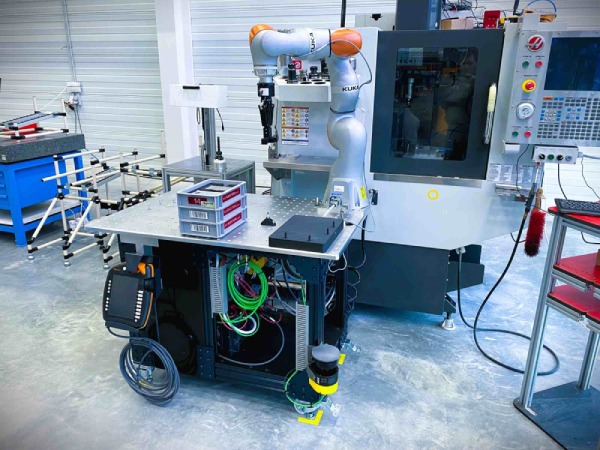
With robotisation, flexibility takes on a concrete significance. A fixed robot cell carries out a pre-defined task in a specified environment. A flexible robotic solution can be adapted to other products, machines or operations with minimal effort. It is not the label “industrial robot” or “cobot” that makes the difference, but the reusability of the entire setup.
Jan Kempeneers, Principal Engineer for Smart Manufacturing at Sirris, advises companies on flexible robot applications. He believes that the distinction between industrial robots and cobots is becoming increasingly blurred.
‘The added value lies in a solution that can switch quickly to a different task and requires relatively little effort in terms of programming or reconfiguration. When dealing with small production runs and a wide variety of products, the robot’s speed is not the only deciding factor. The time and expertise required for each changeover are particularly significant.
A versatile production assistant can, for example, operate various machines or be deployed across several workstations. This means that the same investment can be utilised across several tasks.Whether this is cost-effective in a specific production environment depends on the process as a whole. As well as speed and volume, changeover time, capacity utilisation and suitability for different tasks are also important factors. So the right question to start with is not just: which robot do we need? But also: where are we currently losing time in production due to variation? And what kind of flexibility could reduce this loss?’

When does process automation become smart?
Traditional automation repeats the same action. Flexible automation switches between pre-programmed scenarios. With smart automation, the focus is not on robots, but on machines or systems that detect changes, process data and adjust the way they operate within pre-defined limits. It therefore involves the data-driven adaptation of a defined process. This requires reliable production data.
Tom Jacobs, Principal Engineer for Advanced Machining at Sirris, assists companies in optimising their production processes using machine data. According to him, smart process automation does not start with gathering as much data as possible, but with a specific production requirement.
‘Want to spot a quality issue more quickly? Adjust a machining parameter? Or detect tool wear in good time? Each objective requires different information.
Sensors reveal anomalies. Process data establish links between inputs and outcomes. On that basis, a machine can, for example, adjust the feed rate or cutting speed within pre-set limits. The processing procedure thus responds to what happens during production.A specific question keeps the data project focused and prevents companies from collecting data without using them to inform better decisions.’

How can you make flexible automation a reality?
The transition to flexible, smart automation rarely happens in one go. A targeted feasibility study assesses the technical and economic feasibility. It also highlights practical considerations, such as programming, safety, product supply, changeover times, available data, etc.
It is important to look beyond the robot itself. Interaction with the production environment has to be considered as well.
- A robot needs information about the next order, the sub-tasks, etc.
- A mobile robot needs to know where the materials are ready to be picked up, where they need to go, which route to follow, etc.
- An adaptive machine requires reliable process data and clear limits in order to make adjustments
Different machines and systems must therefore be able to exchange data in order to achieve viable automation. All these aspects can be examined in a feasibility study before you invest.
Jakob Kesteloot, IoT Engineer at Sirris, specialises in connectivity in manufacturing environments. Drawing on this expertise, he emphasises the importance of a targeted, step-by-step approach.
‘Connecting your production doesn’t start with a technology, but with a specific need. So don’t start using an application just because it sounds promising or innovative. First, decide what problem you want to solve with it and what value the application can bring to your manufacturing.
A digitalisation roadmap can help to identify challenges, objectives and potential applications, and to set the right priorities. That doesn’t mean you have to connect your entire manufacturing environment straight away. It is often wiser to start small, with a proof of concept or a feasibility study.
This allows you to assess quickly and with a limited investment whether a technology is technically feasible, provides useful insights and offers sufficient potential. Only once the added value is clear can you decide how to further develop the solution and roll it out more widely.
Sirris developed the “Production Connectivity Toolkit” to help companies with this. With this mobile test setup companies can connect one or more machines under supervision. They do not need to invest in hardware themselves beforehand. This enables them to gain experience on a small scale, assess the potential for further roll-out, and identify and address technical risks at an early stage.’

How Sirris tests automation systems before you invest
Automation only proves its worth in conditions that closely resemble those on the shop floor. That is why it is advisable to carry out testing at an early stage in a realistic production environment. The 4.0 Made Real-demonstrator van Sirris in Genk brings together various technologies in a single pilot line:
- Automated logistics using mobile robots
- An AI-powered processing machine
- Cobot polishing
- A mobile cobot for loading and unloading machinery
- The digital link between various stages of production
The demonstrator does not offer a standard solution, but helps companies to define their own production requirements more precisely. Where does mobility offer an advantage? Which task requires greater flexibility? And what data do machines and systems need to exchange?
A feasibility test or proof of concept provides concrete answers to these questions before the investment is made on the shop floor. This way, you can base your next decision on practical experience rather than on assumptions.
How far along is your automation?

Do you mainly work with fixed robot cells, are you already trialling flexible solutions, or do you use production data to adjust processes? Download the Smart Manufacturing Barometer and find out where other Flemish manufacturing companies stand. What barriers do they have to take into account? What technologies are they already using? And what else do they want to invest in? This will give you a clear point of reference for your own automation decisions.
Discover the other articles in this series
- Smart Manufacturing Barometer 2026
- Bespoke solutions make us strong, but they’re complex
- Four insights: how Flemish manufacturing companies are investing in smart production technology
- From fixed automation to flexible, smart manufacturing ⬅ Current article
- How to make your shop floor smarter through digitalisation
- The factory of tomorrow begins today: five choices that determine your competitive edge
- What Factories of the Future do differently
- P&V Panels automates intelligently in a setting of predominantly bespoke output





