

Link work instructions, production monitoring, and quality control
A shop floor does not become smarter by collecting more data, but by using the right information at the right time. Digital work instructions support operators, production monitoring highlights anomalies, and digital quality control provides feedback to improve processes.
When these applications exchange information, they create a learning cycle that helps improve subsequent production orders. Christophe Michiels, Senior Engineer Smart Assembly at Sirris, explains how companies can build such a digital shop floor step by step.
Digital instructions work both ways
The first link in the learning cycle is the information an operator needs to carry out a task correctly. When tasks and product variants change frequently, paper manuals and separate files quickly become outdated. What is more, finding the right instructions in them takes time.
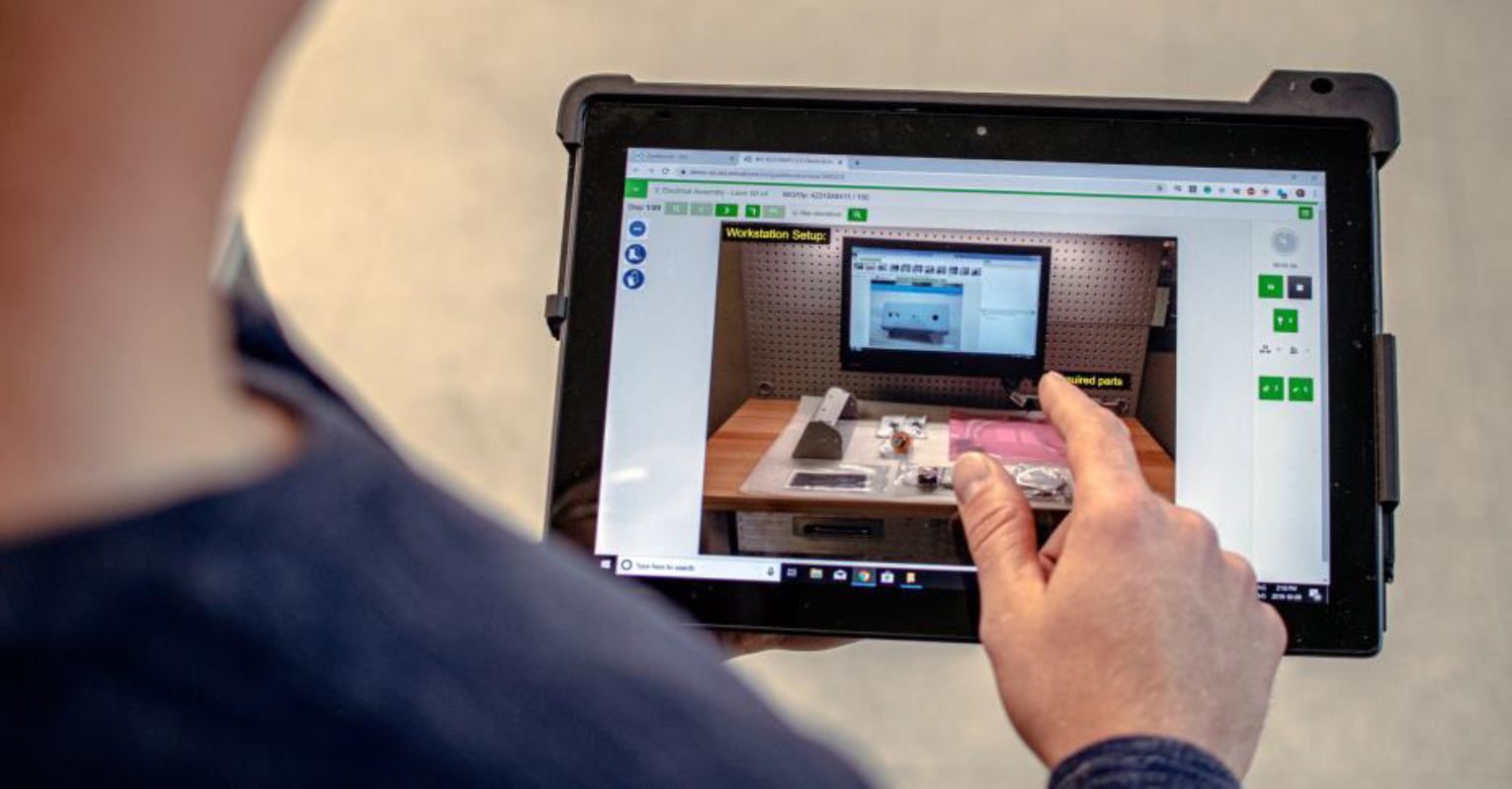
A digital system can automatically adapt instructions to the order and product variant. Photos, videos, and interactive checklists clarify critical tasks. Operators can also confirm that a step has been completed or provide immediate feedback if an instruction is incorrect.
Support is also evolving from individual instructions towards broader process guidance. Systems can indicate when intervention is required, support new staff during training, or suggest possible causes of a fault.
This approach does require clear management. If digital instructions are not systematically updated or continue to exist alongside paper versions, complexity can actually increase. Integration with existing systems, such as ERP and MES, and responsibility for maintenance also require attention from the outset.
In this way, digital work instructions serve both as a tool for operators and as a source of operational data for production monitoring and quality improvement.
‘A digital work instruction clearly tells an operator what needs to be done at each step. To safeguard quality, it ensures that different operators carry out the same work consistently. Digital work instructions also capture knowledge that currently exists only in operators’ minds, making it available to everyone in the future.
But it is equally important that operators can respond immediately if an instruction is unclear or no longer correct. Only when their comments are fed back to the people managing the process does the system become a living tool rather than a digital archive.’
Production monitoring must lead to action
The information from digital work instructions forms part of a broader production overview. A Manufacturing Execution System (MES) can combine it with order and planning data, machine data, and operator logs. This makes it clear which orders are in production, where delays are occurring, and which steps have already been completed.
Many companies build this digital backbone step by step. They first connect machines and other data sources, then use that data in dashboards, and only afterwards apply more advanced analysis to improve processes in a targeted way.
This shared production overview improves coordination between planning and production. However, it only contributes to better execution when it is clear which anomalies require attention and who needs to act on them.
‘The necessary context must be immediately available. Without that focus, the dashboard mainly creates additional search and follow-up work. When data from orders, machines, and the shop floor comes together, you can identify what is happening more quickly and take the right action more effectively.’
Quality control shifts into the production process
While production monitoring shows how an order is progressing, automated quality control focuses on the result during production. Cameras can detect visible defects, while sensors take measurements within the production flow. This allows anomalies to be detected sooner and more consistently than with manual final inspection alone. This is particularly important for small batches.
The added value lies not only in faster detection. Every rejected item has an immediate impact on margins and delivery reliability. A digitally recorded anomaly can be linked to the order, product variant, process settings, and completed instruction steps. This makes it easier to recognise patterns and investigate the cause.
In this way, quality control closes the information loop: the outcome of the production process feeds back to the start of the process.
‘Automated quality control does not necessarily mean that a system independently decides whether to approve or reject something. A system can first flag an anomaly, after which the operator makes the final decision. This allows you to build practical knowledge about normal variation, recurring errors, and possible causes.
But the real benefit comes when that quality information is fed back. Which instruction was followed? Which settings were active? Do we need to adapt the process, the instruction, or the training? In this way, quality control helps not only to identify errors, but also to prevent them systematically.
Only when detection is sufficiently reliable and the process is properly understood can you determine which decisions can be safely automated.’
The applications can reinforce one another
Digital work instructions, production monitoring, and quality control are still often implemented separately. As a result, information can become trapped in separate systems. Their added value increases when relevant data can also flow between the applications.
For example, a quality deviation may prompt an instruction to be clarified or a process setting to be investigated. This requires reliable data and connections that can scale over time. Companies do not need to integrate everything at once, but they should avoid allowing the first application to become an isolated technology silo.
Start with one specific information loop
A feasible first step starts with a recurring problem on the shop floor. This might be an assembly step where operators frequently need to look up information, an anomaly that is only detected at a late stage, or a quality control process whose results are still processed manually.
Map out the entire information loop for that specific application:
- What information does the operator need?
- What data is generated during production?
- How is the result checked?
- Who should take action when an anomaly occurs?
- How do you use the feedback to improve the next production run?
This keeps the application clear and manageable while allowing for future expansion. A targeted test also shows whether the solution works technically, provides sufficiently reliable information, and genuinely fits day-to-day operations.
Conclusion
A smart digital shop floor is not about using as much technology as possible. Start with a specific problem and map out the entire information loop. Then connect instructions, production data, and quality information. This allows you to support operators more effectively, respond more quickly to anomalies, and use feedback to improve each subsequent production order.
Test your complete cycle in Kortrijk
At the Sirris 4.0 Made Real lab in Kortrijk, you can experience various forms of digital support and information flows in a realistic assembly environment.
The Operator Experience Center combines digital work instructions, a connected production environment, digitally supported training, and automated quality control, among other things. This allows companies to test individual applications and investigate which data needs to flow between operators, machines, and systems.
A feasibility test shows:
- What support the operator actually needs
- What data is available and reliable
- How quality information can be fed back
- What integrations are required to expand the application at a later stage
This allows you to test how the applications work together before investing in a solution for your own shop floor.
How digital is your shop floor?

Do your operators always receive the right information? Do you know what happens during production? Do you use quality data to improve instructions and processes in a targeted way? Download the Smart Manufacturing Barometer and compare your approach with that of other Flemish manufacturers. You will discover which applications are already in use, where companies plan to invest further, and which barriers they face.
Ready to build a smarter, more connected digital shop floor?
Discover how to align operator support, production monitoring, and quality control. Discuss your challenge with Christophe Michiels and determine which first step makes sense for your production environment.
Discover the other articles in this series
- Smart Manufacturing Barometer 2026
- Bespoke solutions make us strong, but they’re complex
- Four insights: how Flemish manufacturing companies are investing in smart production technology
- From fixed automation to flexible, smart manufacturing
- How to make your shop floor smarter through digitalisation ⬅ Current article
- The factory of tomorrow begins today: five choices that determine your competitive edge
- What Factories of the Future do differently
- P&V Panels automates intelligently in a setting of predominantly bespoke output


