

How smart automation boosts productivity without limiting bespoke production
How do you automate a production environment in which almost every job is different? For P&V Panels, which was awarded the Factory of the Future label in 2022 and had it renewed in 2025, this is not a theoretical question, but a daily reality. The company designs and assembles electrical distribution and control panels of all sizes for a wide range of sectors.
Bernd Mouchaers, R&D Engineer at P&V Panels, explains how the panel manufacturer is boosting productivity without compromising on the flexibility of bespoke production: ‘By standardising information and automating repeatable sub-tasks, we prevent employees from wasting time searching, waiting and correcting.’
Discover the other articles in this series
- Smart Manufacturing Barometer 2026
- Bespoke solutions make us strong, but they’re complex
- Four insights: how Flemish manufacturing companies are investing in smart production technology
- From fixed automation to flexible, smart manufacturing
- How to make your shop floor smarter through digitalisation
- The factory of tomorrow begins today: five choices that determine your competitive edge
- What Factories of the Future do differently
- P&V Panels automates intelligently in a setting of predominantly bespoke output ⬅ Current article
Batch size one as a starting point
Many manufacturers are moving away from larger production runs towards smaller batches and more customer-specific variants. At P&V Panels, this batch-size-one approach has been standard practice for years. Mouchaers compares their production environment to that of a vehicle factory: ‘Trucks may differ from one another in terms of colour, options or specification, but they are essentially the same product. For us, the starting point also varies considerably. It’s like building everything from a moped to a truck: from small cabinets to installations twenty metres long. And customers sometimes even make changes to their design while production is already under way.’
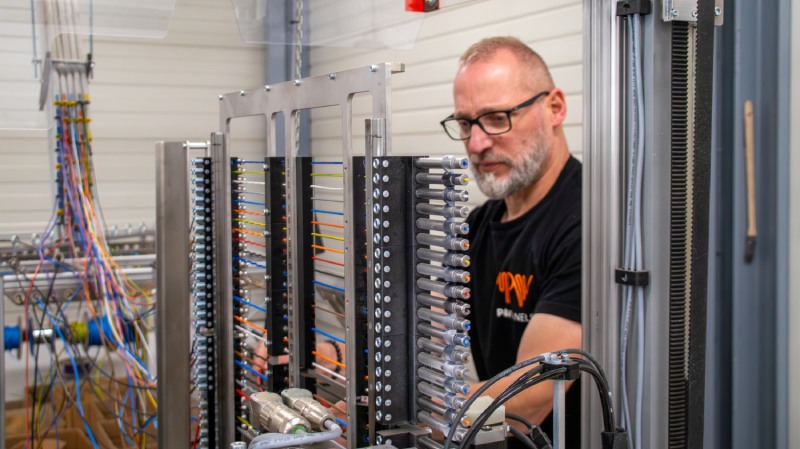
This variety also calls for a different approach to automation from that taken by a manufacturer producing thousands of identical parts. P&V Panels mainly carries out assembly by hand, and fully automating the physical assembly process does not make sense at present. However, many tasks recur in the preparatory work and the flow of information. This is where the company is looking to make gains. ‘We weren’t recognised as a Factory of the Future because the shop floor is full of robots’, adds Mouchaers. ‘It’s because we align technology, processes and people within our own production environment.’
Standardise the basics behind bespoke work
Every project begins with its own design and bill of materials, which may change several times during the process. If engineers have to enter every change manually into the ERP system, the administrative workload can quickly mount up. ‘That’s why we developed an interface that allows an engineer to send the list directly from the EPLAN design software to the ERP system’, explains Mouchaers. ‘This means purchasing and warehouse teams can continue working with the same data.’
In this way, the customer remains free to adapt the panel, while P&V Panels standardises the way information is recorded and communicated. ‘This also applies to smaller details, such as stickers for components’, says Mouchaers. ‘It’s important for them to come out of the system in the correct order. Otherwise, people on the shop floor repeatedly waste time searching.’
Recurring requirements are also recorded in the systems wherever possible. If a customer consistently requests a particular type of label or specification, that knowledge should not be confined to the mind of just one engineer or operator. ‘Recording such parameters digitally reduces the risk of errors when someone is absent or when a project is moved to another site.’
Automate sub-tasks with enough repetition
P&V Panels has been investigating for some time which parts of its physical production process it can automate. A trial some years ago involving a robot that was supposed to carry out all the wiring did not produce the desired result. The team then opted for smaller, clearly defined steps. An automatic wire-cutting machine cuts wires to length in advance and carries out some of the finishing work. CNC machines mill, drill and tap the mounting plates and cabinets. New machines will also further automate the machining of copper rails.
Final assembly is still largely carried out by hand. Automation primarily takes over repetitive preparatory tasks and ensures that the operator can start work with the right materials and information. ‘There is no need to automate the entire process straight away. First, identify the sub-process that involves sufficient repetition’, says Mouchaers. ‘Make a specific economic assessment every single time. A configurator for a customer who places orders three times a year is unlikely to pay for itself. With hundreds of similar orders, however, it can make sense.’
Make production time truly available
For P&V Panels, automation is therefore not an end in itself. Above all, it needs to free up more effective production time for the work that still requires human input. This enables P&V Panels to increase output without people having to work any faster.
It is important to look not just at the assembly process itself, but also at the conditions surrounding it: are the materials available, is the information correct and is everything ready in a practical order? ‘A single missing part can prevent several other components from being assembled’, explains Mouchaers. ‘The operator then has to come up with a temporary solution, set materials aside and start again later. As a result, a low-cost component that is not available on time can have a disproportionately large impact.’
Bring engineering and production together
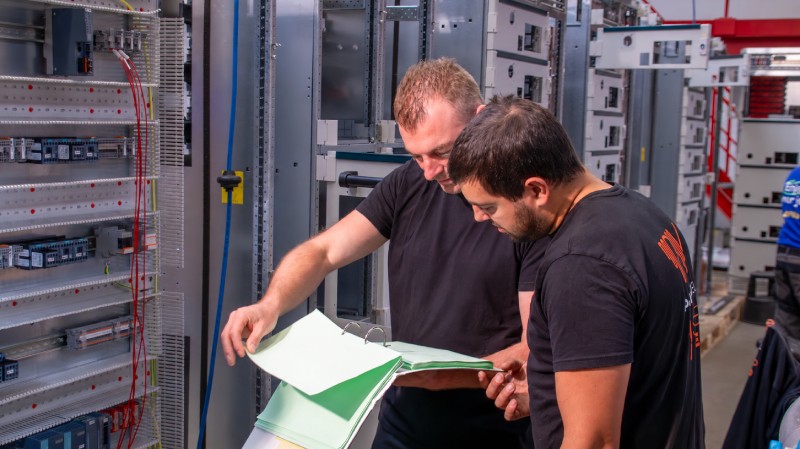
To improve these conditions systematically, problems that arise during the process need to be fed back quickly to engineering. Digital knowledge does not replace discussion on the shop floor. ‘Our engineers check on their ongoing projects in production twice a day’, explains Mouchaers. ‘This way, they notice sooner if components don’t fit, extra accessories are needed or an instruction isn’t clear enough.’ Relevant lessons can then be incorporated into the design systems, so that the next engineer and operator do not encounter the same problem again.
The daily quality meeting in production also takes place on the shop floor. Testers, quality staff and production managers discuss recent issues there. ‘Holding that meeting visibly on the shop floor makes it clear that an error has implications beyond the project in which it was discovered’, explains Mouchaers. ‘The next step remains challenging: human error cannot always be translated easily into a fixed technical measure.’
Give improvement time and ownership
Feedback alone is not enough. To incorporate these insights permanently into systems and working practices, employees also need the necessary time and responsibility. ‘An improvement task that can only be carried out on a quiet Friday afternoon almost always loses out to an urgent customer project’, says Mouchaers. ‘That’s why we’ve freed up staff who can focus systematically on systems and processes. For example, one EPLAN engineer maintains the parts database for the other engineers. A similar role is also emerging within the business for the CRM system.’
According to Mouchaers, an improvement role of this kind needs to remain close to day-to-day practice. An external specialist or IT employee may understand the technology, but does not automatically understand how an engineer designs or how a panel builder assembles. Employees who know the routine and also have an affinity with data and programming can test small improvements more quickly. Larger changes still require collaboration with IT.
Assess AI from a process perspective
This combination of process knowledge, technical skills and ownership also shapes a level-headed view of AI. Mouchaers currently uses generative AI primarily to speed up programming work for the ERP migration and internal applications. ‘We don’t want to move any faster than our processes allow’, he explains. ‘We first want to understand what data, integrations, costs and management efforts are required.’
P&V Panels is therefore prioritising the ongoing ERP migration. Once that foundation is stable, there will be room to explore broader AI applications again.
Start with the next achievable step
All these choices characterise the company’s overall approach to improvement. They do not start with what is technologically possible, but with the next step for which the organisation is ready. Experience shows that bespoke production and productivity do not have to be mutually exclusive. The end product can remain unique, while information, preparation and recurring sub-tasks become increasingly consistent. Progress therefore does not come from one spectacular intervention, but from many small improvements that systematically reduce searching, waiting times and errors.
4 tips from Bernd Mouchaers, R&D Engineer at P&V Panels
- Start small and make sure every action is a real step forward.
- Don’t immediately bring the whole organisation together to solve a single problem.
- Identify what a team can improve straight away and build on that.
- Set aside enough time, otherwise structural improvement will take a back seat to urgent projects.
Plan your next step

Where does your business stand today, and which areas of transformation deserve the most attention? Download the Smart Manufacturing Barometer for an up-to-date frame of reference. Compare your position with that of other Flemish manufacturers and use this to set your priorities more effectively.
Would you like to take things a step further?
With Make the Future, Sirris and Agoria map out your position across the seven areas of transformation. An initial scan of your production organisation helps identify growth opportunities and set priorities that align with your strategy.


