

Two examples from the IRI4WAL project show how to anticipate problems before commissioning
Modifying a production line, connecting an application, or preparing for commissioning involves risks. A control rule that seems logical on paper can throw a whole production line into disarray. In the IRI4WAL project, Sirris has used a digital twin to anticipate these interactions. The aim: to test different solutions in a simulation environment and better prepare for their deployment on actual equipment.
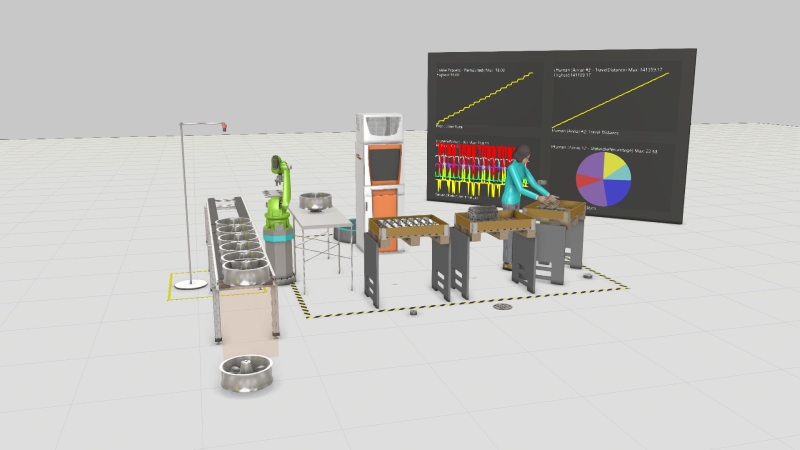
Assembly cell with a cobot - Source: Visual Components
IRI4WAL: relocating sensor production to Wallonia
Industrial Reshoring Initiative for Wallonia, IRI4WAL, is a technological innovation project. It receives support and funding from the Walloon Government as part of the Regional Smart Specialisation Strategy (S3).
The project aims to relocate a production line for sensors intended for Industry 4.0 to Wallonia. Its ambition is to strengthen industrial sovereignty by developing local production and innovation capacity.
Among the project partners are I-care, a Mons-based company specialising in predictive maintenance and industrial equipment monitoring, and Industrie & Développement (iD). I-care is steering the development of the production line and defining the industrial requirements for the sensors, while iD is contributing its expertise in robotics and cobotics.
In this context, Sirris has focused on two challenges relating to commissioning:
- Validating a performance monitoring application based on traceability data
- Testing the control rules for a conveyor equipped with a buffer zone
In both cases, the digital twin makes it possible to examine how a solution works before it is deployed on the actual line.
Why test before carrying out work on the line?
A specification describes how a system is expected to behave. It does not always make it possible to anticipate the effects of a slowdown, a fault, a shutdown, or a change in operating mode.
Work in progress and buffer zones may absorb a disruption, delay it, or shift its effects to another workstation. Testing all these scenarios on a live line is rarely straightforward: machinery and automated systems need to be available, some tests require production to be halted, and it is hard to replicate exactly the same conditions.
The digital twin provides a controlled test environment that replicates the line’s behaviour and enables specific incidents to be simulated. This allows you to compare several options under the same conditions.
In IRI4WAL, Sirris has used this approach to address two specific questions.
- How do you validate a performance monitoring application before connecting it to the equipment?
- How can a conveyor be controlled while taking into account the time required for the manufacturing process?
Testing an OEE application without disrupting production
The first use case involved an industrial performance monitoring application. This application calculates the Overall Equipment Effectiveness (OEE), using traceability data from the production process.
Before connecting the application to the actual equipment, Sirris needed to check two things: the calculation logic and the reliability of the data used. The digital twin generated simulated production events, including changes in production rate, faults, and stoppages.
This information was then sent to the performance monitoring application so that its processing and presentation in a dashboard could be verified. This set-up made it possible to simulate various incidents and check that the application could distinguish between quality losses, slowdowns, and production stoppages.
The simulations also revealed an important point: a local indicator does not always immediately reflect a disturbance that has occurred elsewhere on the line. Depending on how the production process is organised, the effects of an incident may be temporarily absorbed and only become apparent in the performance indicators after some time.
This method makes it possible to test a connected application at an earlier stage, even when the equipment is not yet available. It also helps to avoid confusing calculation problems with the uncertainties inherent in workshop tests.
A conveyor control rule can have unexpected consequences
The second use case involved testing the control of a conveyor equipped with a buffer zone in an automated assembly line. This zone was designed with two objectives in mind: to meet time constraints associated with the manufacturing process and to ensure a steady flow to subsequent production stages.
The simulations showed that control rules that may make sense when considered in isolation can interact in unexpected ways. These observations highlight the importance of testing different scenarios before deploying a solution on actual equipment.
Sirris therefore compared several control strategies in order to identify a more robust approach that was better suited to the simulated operating conditions. The simulations revealed differences in behaviour between the control strategies studied, particularly during restart phases and changes in operating mode.
These results underline the value of comparing different control strategies and of preparing the validation stages on actual equipment more carefully.
A sounder basis for decision-making
A digital twin is of real value when it helps to answer a specific question. It can be used to test an application before the machines are available, it allows control rules to be compared before modifying an automated system; and finally, it makes it easier to analyse incidents that are hard to replicate in the workshop.
To do these things, the model does not necessarily need to represent every mechanical detail. Its level of precision has to reflect the decision to be made.
In the case of the OEE application, the model was primarily intended to replicate the production events required to assess the performance indicators. For the conveyor, it needed to represent the interactions between production flows and control rules. Using this approach, modelling efforts can focus on the elements that are genuinely useful for decision-making, without attempting to reproduce all the line’s technical characteristics.
For your business, the benefit is clear: you can compare several options, identify their limitations, and better prepare for trials on the actual production line. While simulation is no substitute for physical validation, it does enable you to approach this stage with more information and fewer uncertainties.
A digital twin is not just used to visualise a production line. As part of the IRI4WAL project, Sirris used a digital twin to test an OEE application and various rules for controlling a conveyor. The simulations revealed behaviour that was difficult to anticipate and enabled better preparations to be made for the tests on the actual line.
Conclusion
IRI4WAL demonstrates how a digital twin can support industrial decision-making. By simulating an OEE application and various conveyor rules, Sirris identified effects that were hard to predict. This approach helps businesses to anticipate problems, compare their options, and prepare for real-world trials before making any changes to their equipment.
Test your line before it goes live
Are you planning a new production line, a connected application, or a change to the control system? Sirris can help you simulate different scenarios before they are implemented in practice. Together, we can identify the risks and prepare the tests on your equipment.
Discuss your plans with our expert


