How to select bio-based binders for coatings
Choosing bio-based binders for coatings involves more than replacing fossil-based ingredients. Each alternative affects adhesion, hardness, flexibility, and durability. How can you select the right material without compromising performance? Discover the main coating technologies, understand the formulation challenges, and explore a practical selection guide developed within the AddBIO project.
Explore all articles in this series
- Small but powerful ingredients of eco-friendly coatings
- Bio-based additives: make use of your residual waste
- From Field Residue to High-Performance Coatings
- Repurposing eggshell waste as functional coating fillers
- From agricultural waste to performant coatings
- Are bio-based isocyanates in polyurethane coatings a good idea?
- Bio-based anticorrosion additives part 1
- Bio-based anticorrosion additives part 2
- Smarter coating formulation with analytics
- How to select bio-based binders for coatings ⬅ Current article
Why bio-based binder selection matters
The coatings industry is under increasing pressure to reduce its dependence on fossil resources while maintaining the performance levels required for industrial, architectural, and protective coatings. As a result, coating formulators are confronted with a rapidly growing range of bio-based binders, monomers, oligomers, and curing agents entering the market.
However, selecting a bio-based binder is far more complex than simply comparing bio-based content percentages. A coating based on renewable raw materials must still deliver the required combination of adhesion, durability, hardness, flexibility, chemical resistance, and weatherability. The challenge is therefore no longer finding bio-based alternatives, but identifying which bio-based building blocks are technically suitable for a specific coating application. Therefore, simple drop-in solutions often do not offer the best performance. A coating formulation has to be redesigned.
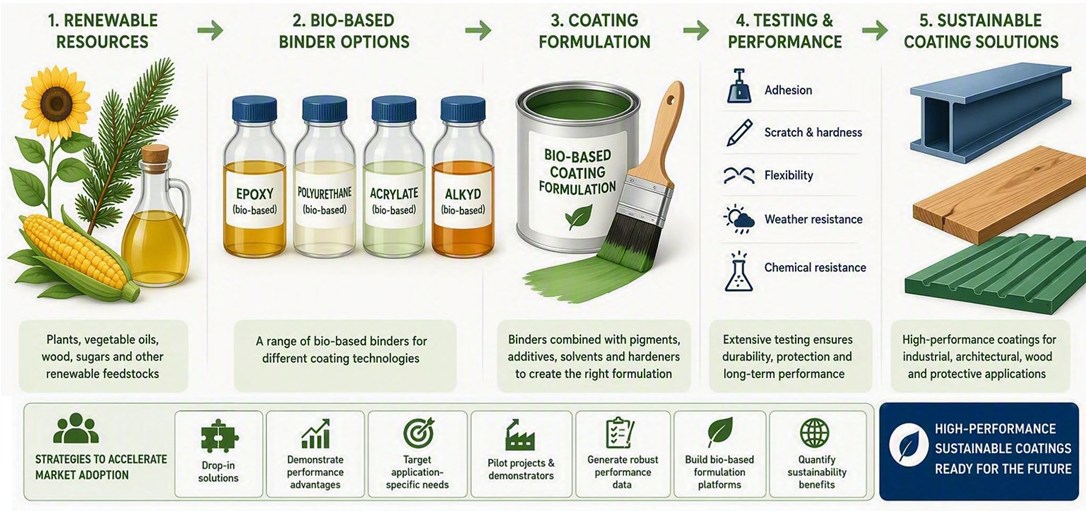
Today, bio-based alternatives are available for various coating chemistries, including epoxy, polyurethane, acrylate, and alkyd systems. While these materials offer sustainability benefits, they often introduce different molecular structures that influence coating performance in unique ways. Selecting compatible components and suitable curing conditions can improve the performance of bio-based coatings compared with fossil-based coatings.
To aid the selection of appropriate bio-based components for coatings from the industrial market, a non-limiting selection guide has been compiled.
Explore bio-based options for your coatings
Looking for renewable building blocks for your next coating formulation? The AddBIO guide, Bio-based building blocks for coating formulations, provides an overview of commercially available products and suppliers for epoxy, polyurethane, acrylate, and alkyd coatings. Discover promising materials to support your next formulation project.
Four bio-based coating technologies to explore
Epoxy coatings: renewable alternatives for demanding applications
The epoxy sector currently offers one of the widest ranges of bio-based alternatives. Commercial solutions include bio-based epoxy resins derived from epoxidised vegetable oils, epoxidised pine oil derivatives, isosorbide-based epoxides, cardanol-derived epoxy resins, or bio-based epichlorohydrin routes.
Several suppliers now offer bio-based epoxy systems with renewable content well above 50%, while some specialised products claim nearly complete replacement of fossil-derived epoxy precursors.
Polyurethane coatings: balancing hardness and flexibility
Bio-based polyurethane chemistry has evolved significantly during the past decade. The strongest growth can be observed in bio-based polyols derived from vegetable oils (e.g., castor oil and rapeseed), isosorbide, sorbitol, succinic acid, bio-based 1,3-propanediol, or bio-based polyester intermediates.
The availability of bio-based polyols allows formulators to tailor flexibility, hardness, and hydrolytic stability according to application requirements. In parallel, emerging bio-based diisocyanates, such as pentamethylene diisocyanate (PDI), are enabling higher renewable content in high-performance polyurethane coatings.
Acrylate coatings: opportunities for UV curing
The transition towards bio-based acrylate coatings is accelerating, particularly in UV-curable technologies where renewable reactive diluents and oligomers can be directly incorporated into the formulation. Recent developments include bio-based acrylate oligomers, acrylated vegetable oil derivatives, bio-based methacrylates, renewable acrylic dispersions, and UV-curable bio-based resin systems. The availability of bio-based acrylates is particularly interesting because UV-curable coatings can simultaneously achieve high solids content, low VOC emissions, fast curing, excellent mechanical performance, and a reduced environmental footprint. For formulators, the most important evaluation parameters include reactivity, viscosity, functionality, hardness development, and compatibility with existing UV-curing processes.
Alkyd coatings: building on renewable chemistry
Alkyd resins already possess a strong connection with renewable raw materials because they traditionally contain substantial amounts of vegetable oils. Nevertheless, new developments are pushing bio-based content even further. Modern bio-based alkyd systems incorporate renewable fatty acids, plant-derived polyols, bio-based additives, renewable rheology modifiers, and bio-based dispersants. These developments allow manufacturers to reduce fossil carbon content while maintaining the processing characteristics and application properties expected from decorative and industrial alkyd coatings.
What holds bio-based coatings back?
Despite the rapid growth in commercially available bio-based binders, the transition from fossil-based to renewable coating technologies remains gradual. The main challenge is that sustainability alone is rarely sufficient to drive market adoption. Coating manufacturers and end users ultimately require products that match or exceed the performance, reliability, and cost-effectiveness of established technologies. Four key challenges still slow the adoption of bio-based coatings.
First, there is often a performance gap between novel bio-based materials and mature fossil-derived counterparts. While significant progress has been made in bio-based epoxy, polyurethane, and acrylate systems, some bio-based building blocks may still exhibit limitations in terms of chemical resistance, weatherability, hardness, thermal stability, or service lifetime. Additional formulation work is therefore frequently needed to achieve equivalent performance.
Second, economic considerations remain a major barrier. Bio-based raw materials are often produced on a smaller scale and involve more complex supply chains, resulting in higher raw material prices and increased formulation costs. In many coating applications, customers are not yet willing to pay a significant premium for renewable content alone, especially when performance benefits are not immediately evident.
A third challenge concerns the availability and consistency of biomass-derived feedstocks. Unlike petrochemical raw materials, renewable resources can be influenced by agricultural yields, seasonal variations, geographical factors, and competing applications in food, fuels, and other bio-based industries. This may create uncertainty regarding long-term supply and price stability.
Finally, the sector still faces difficulties related to standardisation and certification. Different methodologies are used to calculate and communicate bio-based content, carbon footprint, and sustainability claims. As a result, it can be difficult for coating manufacturers and end users to compare products objectively and assess their true environmental impact. Clear and harmonised standards are needed to support market confidence and accelerate adoption.
Nevertheless, the increasing availability of commercial bio-based binders, combined with advances in formulation science, analytical characterisation, and performance testing, suggests that many of these barriers can be progressively overcome. The most successful future coating systems will likely be those that combine high renewable content with performance levels that fully meet industrial requirements.
How to bring bio-based coatings to market
Although the availability of bio-based binders is increasing rapidly, market adoption often remains slower than anticipated. In many sectors, coating users are primarily concerned with performance, reliability, regulatory compliance, and cost rather than the renewable content of the formulation itself. Successful commercialisation therefore requires strategies that go beyond simply introducing a new bio-based raw material.
Several practical approaches can help accelerate the adoption of bio-based coating technologies:
• Prioritise drop-in solutions. Bio-based binders that can be incorporated into existing formulations and production lines with minimal process modifications significantly lower adoption barriers. Partial substitution of fossil-derived components is often more readily accepted than complete reformulation.
• Focus on performance advantages rather than sustainability alone. Bio-based materials such as cardanol derivatives, isosorbide-based building blocks, or specialised vegetable oil derivatives may deliver additional benefits, including improved flexibility, enhanced hydrophobicity, lower VOC content, or better adhesion. These advantages can provide stronger market drivers than renewable content alone.
• Develop application-specific formulations. Rather than promoting generic bio-based coatings, formulators should target specific market needs such as corrosion protection, wood coatings, flooring, industrial maintenance, or UV-curable coatings. Demonstrating performance in a defined application greatly increases market confidence.
• Use demonstrator projects and pilot applications. End users often require proof under realistic operating conditions before adopting new technologies. Pilot projects can provide valuable evidence regarding durability, processability, and long-term performance.
• Generate robust performance data. Comprehensive testing of mechanical properties, weathering resistance, chemical resistance, adhesion, and durability helps overcome market hesitation. Independent validation and benchmarking against conventional products can further strengthen acceptance.
• Build formulation platforms rather than individual products. Combining multiple bio-based building blocks, such as bio-based binders, reactive diluents, dispersants, and additives, enables the development of formulation concepts that can be adapted to different industrial requirements.
• Quantify sustainability benefits. Life-cycle assessment, renewable carbon content, carbon footprint reduction, and regulatory compliance data can support purchasing decisions and help customers meet their own sustainability targets.
Ultimately, the fastest route to market adoption is demonstrating that bio-based coatings can deliver equivalent or superior performance while simultaneously contributing to sustainability objectives. The combination of informed raw material selection, systematic formulation development, analytical characterisation, and application-oriented validation will be crucial for transforming promising bio-based building blocks into commercially successful coating products.
Why testing makes the difference
While databases, supplier information, and molecular design principles can significantly narrow down the selection of promising bio-based binders, successful coating development still requires experimental formulation and testing. The performance of a coating is rarely determined by a single bio-based building block. Instead, coating properties emerge from the interactions between binders, reactive diluents, curing agents, pigments, fillers, and additives within the final formulation. Different combinations of bio-based components may lead to substantial variations in viscosity, curing kinetics, crosslink density, film formation, adhesion, and long-term durability.
For this reason, systematic formulation studies remain essential. Experimental screening allows formulators to identify synergistic combinations of bio-based building blocks and to evaluate trade-offs between sustainability and performance. Properties such as hardness, flexibility, abrasion resistance, chemical resistance, water uptake, weatherability, and adhesion must ultimately be verified through laboratory testing. By combining knowledge of available bio-based raw materials with targeted formulation experiments and performance characterisation, coating developers can accelerate the transition towards high-performance, sustainable coating systems while minimising development risks.

Conclusion
Bio-based binders offer new opportunities for more sustainable, high-performance coatings. Success depends on choosing the right chemistry, optimising formulations, and validating performance under realistic conditions. With the AddBIO selection guide, Sirris helps you identify promising materials and make informed development decisions. The next step is turning these options into tested coating solutions.
Summary
Selecting bio-based binders requires more than comparing renewable content. Epoxy, polyurethane, acrylate, and alkyd systems offer promising alternatives, but performance depends on formulation and testing. Sirris helps coating developers explore suitable materials and assess their potential. Discover the AddBIO selection guide to support your next formulation project.
Explore bio-based options for your coatings
Within the AddBIO project, a comprehensive overview has been compiled of commercially available bio-based building blocks for coating formulations. It provides examples of suppliers, commercial products, and renewable raw material platforms that can support the development of more sustainable coating systems. Download the AddBIO selection guide or contact Sirris to explore your formulation challenges.
For more information, contact: Pieter.samyn@sirris.be
Partners