What are composites, how do they work, and what different types are there?
Composites? The word might not ring a bell straight away. Yet you’ll find these materials everywhere: in wind turbines, aeroplanes, boats, and cars. They combine low weight with high strength. But what makes composites so special? How are they constructed, and what types are there? Find out how these versatile materials work and what opportunities they offer for a circular economy.
Would you like to find out which composites are suitable for your application?
Sirris can help you with material selection, processing, and circular solutions.
Contact our expert
What are composites and how do they work?
You can compare composites to reinforced concrete. The steel provides the strength, while the concrete holds everything together. In composites, fibres, such as glass fibres or carbon fibres, serve the same purpose. They provide strength and stiffness, while a polymer (or, as it is commonly known, plastic, although materials engineers may not always thank you for using the term) binds the fibres together and gives the material its shape. A composite thus combines the best of both worlds: low weight and high mechanical performance.
Why are composites so strong?
The strength of composites lies in the clever interaction between fibres and polymer. The fibres provide strength and stiffness, while the polymer matrix holds everything together and distributes the forces. But there’s more. By orienting the fibres in a specific direction, manufacturers can reinforce the material precisely where it is needed. The result is a lightweight material that can nevertheless withstand considerable forces. This makes composites particularly attractive for planes, cars, and wind turbines, where every kilogram counts. A composite’s ultimate strength depends on the fibres used, the polymer matrix and the fibres’ orientation.
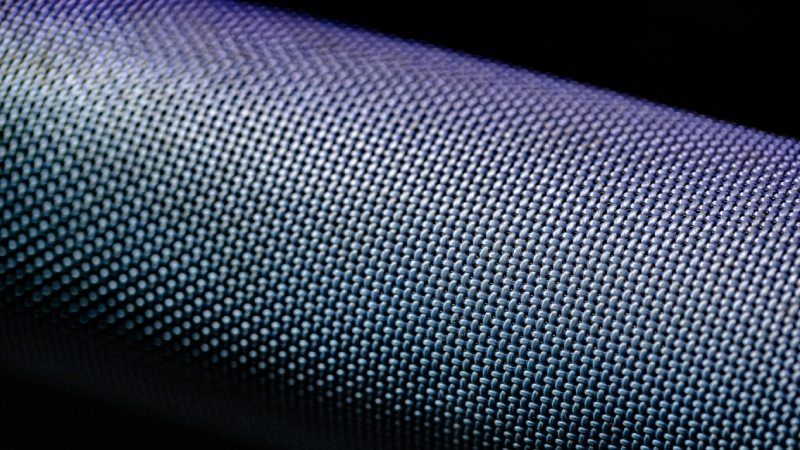
Two major families: thermosets and thermoplastics
A composite consists of a reinforcing material, usually fibres, and a matrix that holds the fibres together. Based on that matrix, we often distinguish between thermosetting and thermoplastic composites.
Thermosetting composites: strong and dimensionally stable
Thermosets, or thermosetting polymers, form a permanent network during the production process. Once cured, they cannot be remelted and reshaped like a thermoplastic. When reheated, the material doesn’t become liquid. At high enough temperatures, it eventually starts to break down.
A familiar example is Bakelite, one of the first fully synthetic plastics, which you may know from old telephones, switches or sockets. Due to their high strength and heat resistance, thermosetting composites are still widely used today, for example in wind turbine blades, boats, and aircraft components. However, as they cannot be remelted, recycling them is more labour-intensive.
Thermoplastic composites: reprocessable
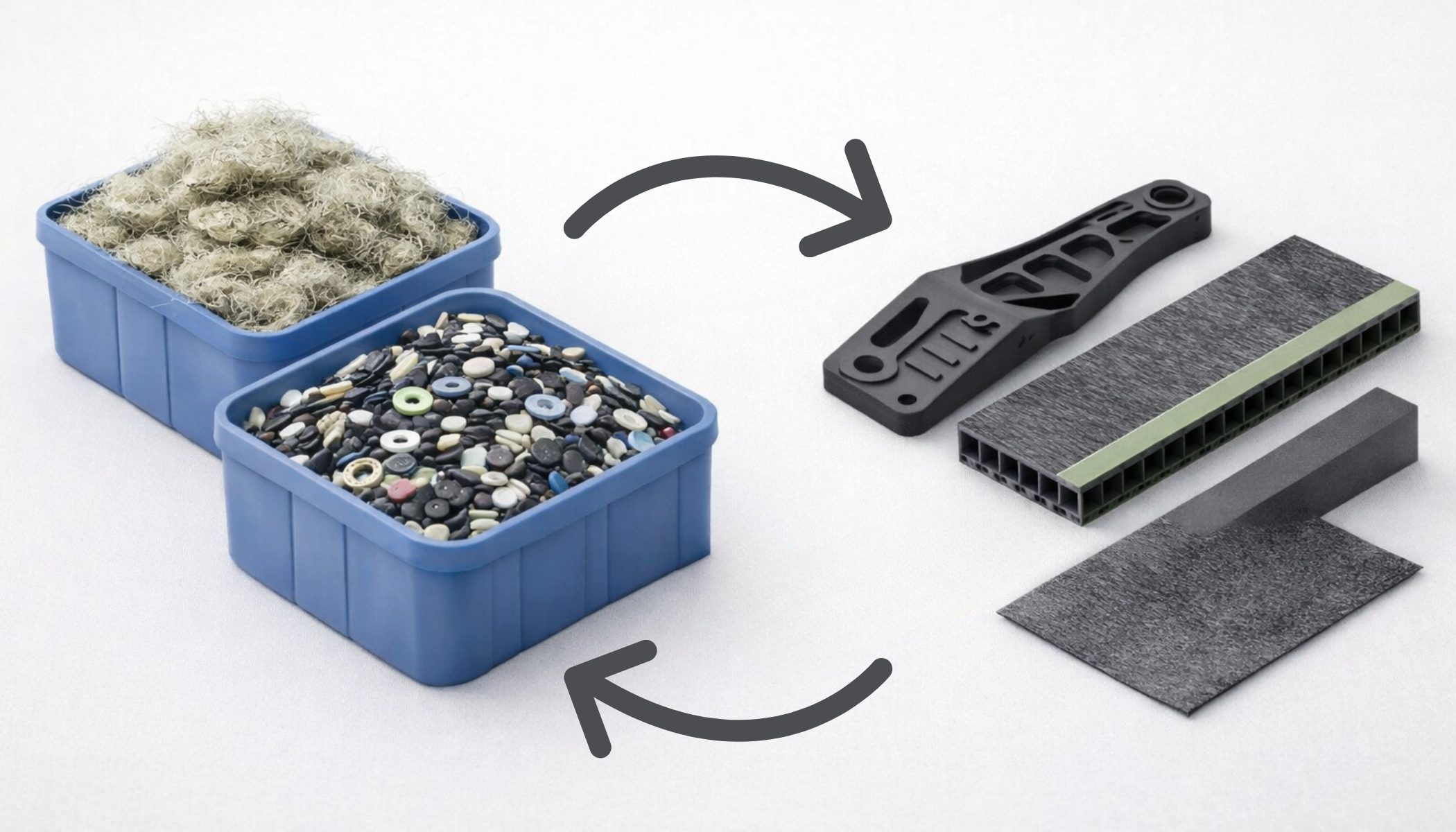
A second group of polymers is thermoplastics. Unlike thermosets, these can be reheated, melted, and reprocessed. This means that components can be recycled at the end of their useful life and serve as raw materials for new products.
This property makes thermoplastic composites an attractive option in a circular economy. As the matrix can be remelted, there are opportunities to reprocess the material. How often and in what way this is possible depends, among other things, on the fibres, matrix, and processing technique used.
What types of fibres reinforce composites?
There are various types of fibres that are used as reinforcements in composites. The most common are glass fibres, carbon fibres, aramid fibres, and natural fibres. Each type has specific properties, and the choice will depend on the application and the desired combination of strength, stiffness, weight, and cost.
Glass fibres: strong and affordable
Glass fibres are the most commonly used reinforcing fibres in composites. They combine high strength, good stiffness, and low cost, making them suitable for a wide range of applications, such as wind turbine blades, boats, and car parts.
Carbon fibres: light and stiff
Carbon fibres generally have a higher specific strength and stiffness than glass fibres. As a result, they are used in applications where low weight and high performance are important, such as planes, racing cars, and sports equipment. Their higher cost limits their use in mass production.
Aramid fibres: impact-resistant
Aramid fibres, such as Kevlar, combine low weight with excellent impact resistance. Manufacturers use them primarily in protective clothing, helmets, and bulletproof vests, but also in sports and aviation applications.
Natural fibres: a renewable alternative
Natural fibres such as flax and hemp are light and derived from renewable raw materials. They are therefore increasingly being investigated as an alternative to synthetic reinforcing fibres. Although they are not as strong as glass or carbon fibres, their use is becoming more common in car interiors, furniture and biocomposites, where sustainability is an important factor.
What role do composites play in the circular economy?
Composites offer interesting opportunities for a circular economy, but they also present challenges. Because they are so light, they can reduce the energy consumption of vehicles, for example. Furthermore, many composites are long-lasting, which means that parts don’t need to be replaced as often. However, recycling remains a key concern. Thermosetting composites, in particular, are difficult to recycle because their polymer matrix cannot be remelted. Thermoplastic composites offer more possibilities in this regard, as manufacturers can reheat and reprocess them under certain conditions. Natural fibres and new recycling techniques can also help make composites more sustainable. The challenge is to develop materials that aren’t just strong and light, but also last longer, can be repaired and regain value after use.
Conclusion
Composites offer a wide range of possibilities when strength, weight, and durability are important. The right combination of fibres and matrix determines their performance. At the same time, circularity requires careful choices of materials and suitable recycling techniques. If these properties are understood, more effective use can be made of composites in innovative products.
Join the Belgian composites community
Join a community that brings together expertise, innovation and collaboration across the Belgian composites value chain. Connect with peers, discover new opportunities and help shape the future of composites in Belgium.