How can bio-based raw materials improve coating sustainability and performance?
Residual biomass can provide functional ingredients for coatings, from fillers and corrosion inhibitors to renewable crosslinkers. Its value depends on choosing the right processing route and how well the resulting material matches the coating system.
These examples connect environmental assessment, material processing, formulation, and analytical testing. They offer practical starting points for selecting bio-based additives and binders without losing sight of compatibility, durability, or application requirements.
Explore bio-based additives for coatings
Discover practical processing routes and applications for turning residual biomass into functional coating additives.
What can you expect?
- Assess the full environmental impact
- Choose a suitable biomass processing route
- Explore calendula residues as functional fillers
- Replace mineral fillers with eggshell-derived calcium carbonate
- Tailor rice husk additives through pyrolysis
- Evaluate bio-based isocyanates for polyurethane coatings
- Understand how bio-based anticorrosion additives work
- Match anticorrosion additives to their application
- Use analytical techniques to guide coating formulation
- Choose bio-based binders for your coating
1. Assess the full environmental impact
Additives often represent only a small proportion of a coating, yet they strongly influence its functionality, service life, and environmental impact. Renewable origin alone therefore does not guarantee a better solution.

A simplified life cycle assessment compares raw materials, processing requirements, and coating service life early in development. It helps distinguish additives with a genuinely lower environmental footprint from alternatives whose intensive processing may offset part of their environmental benefit.
2. Choose a suitable biomass processing route
Biomass can rarely be incorporated into a coating without modification. Its particle size, structure, or surface usually needs to be adapted to achieve the required dispersion, compatibility, and functionality.
Mechanical, chemical, biochemical, and thermomechanical processes modify biomass in different ways. Grinding can control particle size, chemical treatments can change surface properties, biological conversion can produce functional components, and pyrolysis can generate carbon-rich additives.
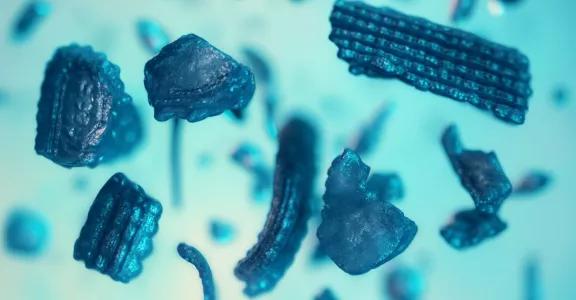
3. Explore calendula residues as functional fillers
Residues left after extracting calendula seed oil retain a fibrous, porous structure, reactive hydroxyl groups, proteins, and pigments that can fulfil various functions in coatings.

After drying and milling, these residues can contribute to rheology control, matting effects, weight reduction, or crack resistance. Surface modification may improve compatibility and water resistance, while conversion into biochar offers opportunities for specialised coatings.
4. Replace mineral fillers with eggshell-derived calcium carbonate
Eggshell waste contains biogenic calcium carbonate with a porous, irregular morphology. This makes it a promising circular alternative to conventionally mined mineral fillers for coatings.
Tests in a bio-based epoxy coating showed good dispersion and hardness comparable to conventional calcium carbonate. At higher filler loadings, the eggshell-derived filler delivered equal or better abrasion resistance while maintaining hydrophobicity and supporting gloss and levelling.

5. Tailor rice husk additives through pyrolysis
Rice husk combines carbon-rich organic matter with naturally occurring silica. Pyrolysis conditions determine how this agricultural residue behaves as a functional coating additive.

Lower conversion temperatures preserve a carbon-rich fraction that interacts strongly with epoxy, whereas higher temperatures produce a more inert, silica-rich filler. Particle geometry and filler loading also influence hardness and wear protection. Application-specific testing therefore remains essential.
6. Evaluate bio-based isocyanates for polyurethane coatings
Bio-based pentamethylene diisocyanate (PDI) offers a renewable alternative to conventional hexamethylene diisocyanate (HDI) in polyurethane coatings. However, its performance must be assessed under relevant conditions of use.
Comparative research showed higher hardness, scratch resistance, wear resistance, gloss, and hydrophobicity for PDI-based coatings. Their thermal stability was slightly lower. This highlights why curing behaviour, the substrate, and expected exposure conditions must remain part of formulation decisions.
7. Understand how bio-based anticorrosion additives work
Bio-based anticorrosion additives support established protection mechanisms by slowing the penetration of water, oxygen, and ions through barrier effects, inhibiting electrochemical reactions, or helping to form protective layers on the metal surface.
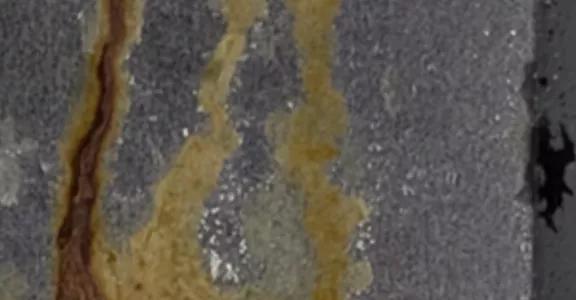
They can act as corrosion inhibitors, functional fillers, or smart additives with controlled-release or self-healing behaviour. Their effectiveness depends on chemical structure, particle size, surface chemistry, dispersion quality, and compatibility with the coating matrix.
8. Match anticorrosion additives to their application
Corrosive environments vary considerably across infrastructure, marine applications, transport, energy systems, and electronics. No single biomass-derived additive or coating system is therefore suitable for every application.
Tannins can support passivation, chitosan can form protective films, lignin offers stabilising functions, vegetable oils can form hydrophobic networks, and nanocellulose can reinforce coatings or carry active corrosion inhibitors. Testing under realistic exposure conditions remains essential.
Match bio-based anticorrosion additives to their application

9. Use analytical techniques to guide coating formulation
Additive concentration alone cannot explain coating performance. Dispersion, interfacial adhesion, and interactions with the polymer network often determine whether a formulation succeeds.
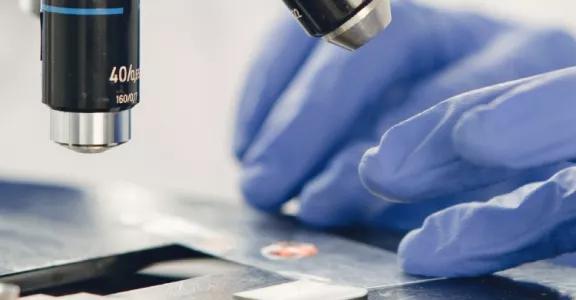
Analytical techniques link composition, microstructure, and properties. Converting measurements of chemical interactions, molecular mobility, rheology, morphology, and surface compatibility into numerical parameters can support predictive models and reduce empirical trial-and-error testing.
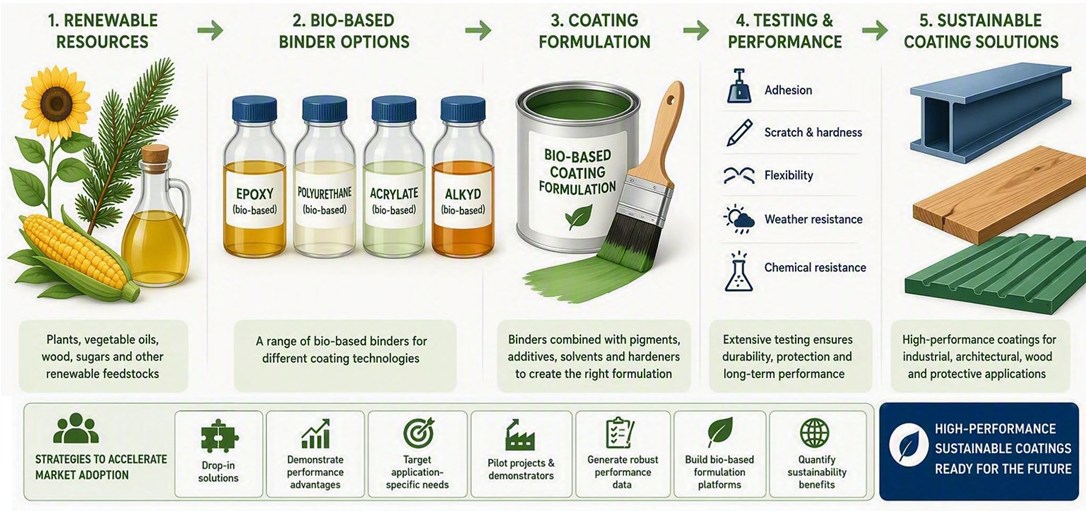
10. Choose bio-based binders for your coating
The proportion of renewable raw materials alone does not determine whether a binder is suitable. Adhesion, hardness, flexibility, chemical resistance, weather resistance, and durability must also meet the requirements of the intended application.
Epoxy, polyurethane, acrylate, and alkyd systems each offer bio-based options with their own formulation challenges. The non-exhaustive AddBIO selection guide brings together commercially available products and suppliers. Use this overview as a starting point and verify the final properties through targeted testing.
Turn residual biomass into functional coating additives
The AddBIO white paper describes mechanical, chemical, biochemical, and thermomechanical processing technologies, supported by industrial examples, test results, and guidance for choosing a suitable processing route.
AddBIO | Bio-based additives for high-performance coatings
AddBIO develops practical knowledge and tools for selecting, preparing, testing, and integrating bio-based additives. The project brings together organisations across the value chain and focuses on fire retardancy, corrosion protection, and water resistance.