

Move from trial and error to predictive, knowledge-based coating design
Coating formulation still relies heavily on trial and error. But what if analytical data could help you predict performance before extensive laboratory testing? By linking composition, structure, and performance, analytical coating design helps you make better formulation decisions, reduce testing, and understand why a coating succeeds or fails.

Implementing an analytical coating formulation approach involves shifting coating development from a predominantly empirical, trial-and-error process towards a data-driven methodology based on scientific understanding of composition, structure, processing, and performance relationships. In this approach, analytical chemistry and material characterisation techniques provide quantitative information that guides formulation decisions, accelerates development, reduces raw material consumption, and improves product robustness.
In knowledge-based coating design, one of the biggest challenges is understanding the role of additives. Formulators traditionally describe a coating by stating that it contains 2% dispersant, 5% wax, or 10% lignin filler. However, these numbers alone tell us very little about how an additive actually influences coating performance. In reality, coating performance is governed not by additive concentration, but by the interaction between the additive and the polymer matrix. Two coatings containing exactly the same amount of additives may exhibit dramatically different adhesion, corrosion resistance, barrier properties, or toughness because the additives interact differently with the coating network. Thus, for predictive design, additive–matrix interactions are often more important than the additive concentration itself. In an epoxy coating, a dispersant, toughener, silane, wax, corrosion inhibitor, or bio-based additive only works because it interacts with the polymer network, and performance is determined by interphase properties and additive dispersion.
Why additive-matrix interactions matter
Consider an epoxy coating containing bio-based fillers such as lignin, cellulose, and biochar. Simply knowing that the coating formulation contains a concentration of 10 wt% filler provides very limited information. What really matters is how the additive is integrated into the coating and interacts with its environment, for example, whether it:
- Participates in hydrogen bonding with the epoxy network
- Alters crosslink density
- Improves or worsens particle dispersion
- Creates interfacial voids
- Restricts polymer mobility
- Changes water transport properties
These effects ultimately determine coating performance.
In many industrial datasets, these interaction descriptors become far more predictive than the nominal additive loading because they capture the actual chemistry and microstructure of the coating-additive system. From a machine-learning-supported design perspective, additive concentration is often a weak predictor. Quantitative interaction descriptors, on the other hand, directly capture the underlying chemistry and microstructure responsible for performance.
A key objective of modern analytical coating science is therefore to transform qualitative concepts such as "good compatibility" or "strong interaction" into measurable numerical features.
How analytical coating design reduces trial and error
Traditional coating formulation often relies on iterative adjustments of binders, pigments, fillers, solvents, and additives until the desired performance is achieved. While effective, this approach can be time-consuming and may not reveal the underlying reasons for success or failure. The real power of an analytical coating formulation approach lies not in characterisation itself, but in using analytical data to predict coating performance before running long-term tests while optimising the final coating performance.
An analytical formulation strategy seeks to answer fundamental questions such as:
- What is the exact chemical composition of the coating?
- How are the components distributed within the coating?
- How do molecular interactions influence rheology, film formation, and curing?
- Which formulation parameters most strongly affect durability, adhesion, barrier properties, or appearance?
- How can performance be predicted before extensive testing?
By understanding these relationships, formulators can design coatings with greater precision and confidence.
Linking coating composition, structure and performance
Composition–structure–property relationships in coatings describe how the ingredients used in a coating determine its internal structure, which ultimately governs performance. The composition includes the binder, pigments, fillers, additives, solvents, and crosslinkers. These components interact during formulation, application, and curing to create a specific microstructure characterised by crosslink density, phase distribution, porosity, particle dispersion, interfacial adhesion, and surface morphology (Figure 1).
The resulting structure directly influences coating properties such as hardness, flexibility, adhesion, chemical resistance, corrosion protection, gloss, and durability. For example, increasing epoxy crosslink density may improve chemical resistance and hardness but can reduce flexibility. Similarly, better dispersion of pigments and fillers can enhance barrier properties and mechanical performance, while poor dispersion may create defects that accelerate degradation (Figure 2).
Understanding these relationships allows formulators to move beyond empirical trial-and-error approaches. By linking composition to structure and structure to performance through analytical techniques such as FTIR, DSC, DMA, rheology, and microscopy, coating scientists can develop predictive models that enable data-driven design and optimisation of advanced coating systems.
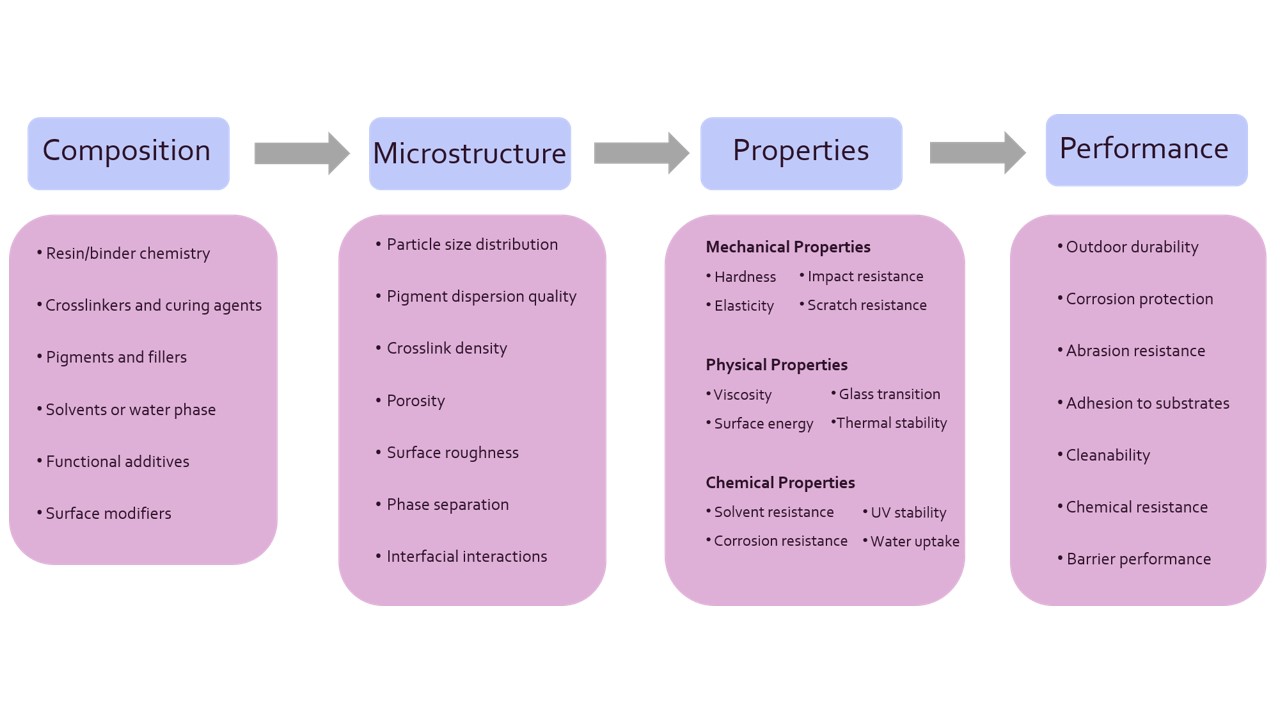
Figure 1: Building structure–property relationships through understanding fundamental parameters at different levels along the coating development process.
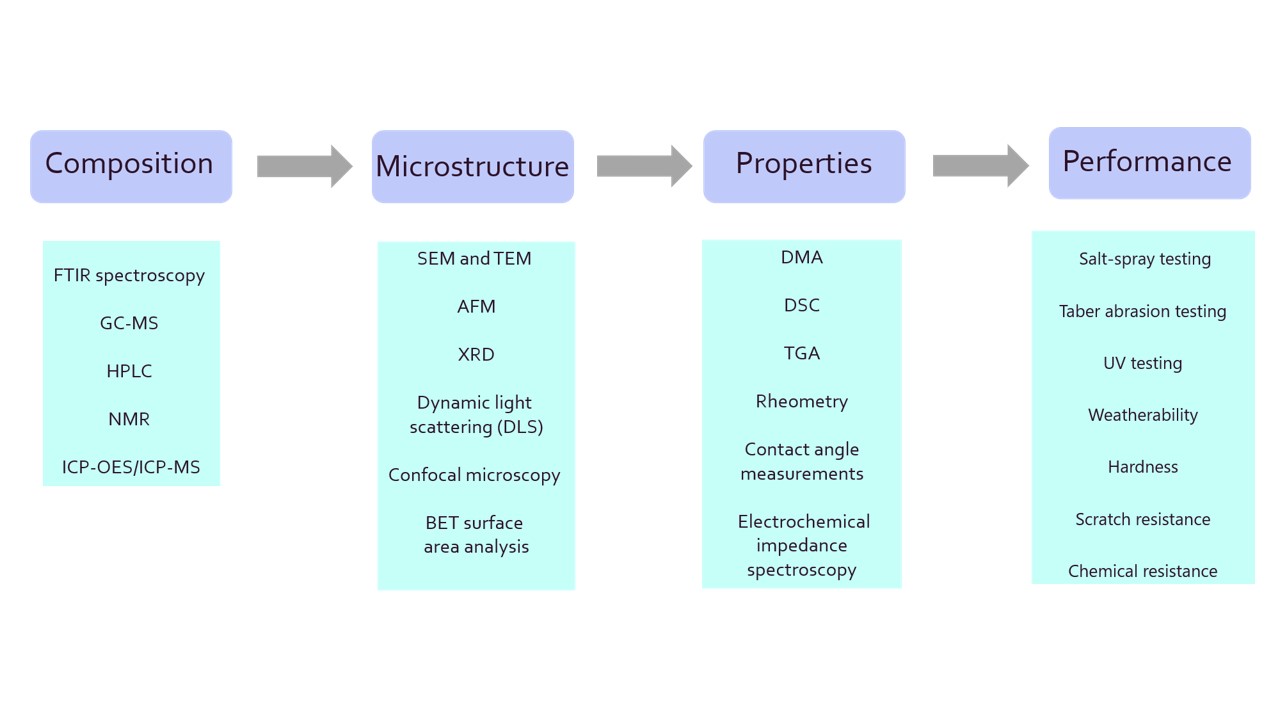
Figure 2: Availability of different analytical tools to be employed during different phases of coating design and development.
From analytical data to predictive coating design
The future of coating formulation lies in combining analytical chemistry, materials science, and data science. Rather than performing endless experimental iterations, formulators can increasingly rely on measurable interaction descriptors that capture the true behaviour of additives within the coating matrix. Within different phases of coating design and development, analytical tools can help guide optimisation of the coating formulation and support decision-making (Figure 2).
Feature engineering is arguably the most important step in building predictive coating-performance models. In coating science, raw analytical data are rarely the best ML inputs. Instead, we transform analytical measurements into descriptors that capture the underlying physics and chemistry of the coating. This process is called feature engineering.
For epoxy coatings, valuable measurements often come from:
- FTIR for chemical interactions
- DSC for network modification
- DMA for molecular mobility and rheology
- Rheology for microstructural development
- SEM for morphology and fracture behaviour
- Contact angle analysis for compatibility
By converting these measurements into numerical features, coating scientists can create predictive models that estimate adhesion, barrier properties, corrosion resistance, toughness, and long-term durability. The result is a shift from empirical formulation towards data-driven coating design, where understanding additive–matrix interactions becomes the foundation of next-generation predictive coating technology. In parallel, analytical techniques can support fracture and failure analysis of coating systems. As most coating failures originate from a limited number of underlying material parameters, the goal is to identify measurable analytical descriptors that drive performance.
Put analytical coating design into practice
Would you like to formulate more effectively and better understand how bio-based additives influence coating performance? Within the AddBIO project, Sirris and its partners investigate how bio-based additives can be selected, characterised, and integrated into high-performance coatings. Using various analytical techniques, we map their influence on coating properties and performance. Our test laboratories also offer a range of techniques to support coating formulation and failure analysis.
In short
Analytical coating design helps you move beyond trial and error. By measuring additive-matrix interactions and linking composition, structure, and performance, you gain stronger insights into coating behaviour. These data can support formulation decisions, predictive models, and faster development of robust coatings.
Conclusion: from measurements to better coating decisions
Analytical techniques do more than explain coating performance after testing. They can guide formulation decisions from the start. By measuring additive-matrix interactions and translating them into useful data, you can reduce trial and error, strengthen predictive models, and develop more robust coating systems.
Partners


