

How manufacturers close the gap between promising technology and real productivity impact
Flemish manufacturers rarely compete on price alone. Their strength lies in quality, flexibility and customer-specific solutions. Many produce in small series, often operating according to make-to-order or engineer-to-order models. That focus on customisation creates a competitive advantage, but it also significantly increases the complexity of production processes.
Furthermore, productivity growth is no longer optional in a context of volatile supply chains, talent shortages, geopolitical risks and energy constraints. Productivity growth is a strategic necessity. Automation, digitalisation and AI are therefore increasingly important levers for manufacturers.
Digital technologies can deliver clear benefits in a controlled environment. The harder part often comes next: integrating the solution into day-to-day operations, maintaining it over time and demonstrating sufficient business value to justify further investment.
According to the Smart Manufacturing Barometer 2026, a study by Sirris based on insights from more than 90 Flemish manufacturing companies, 41% cite uncertainty about the business case as the main barrier to further digitalisation. Resistance on the shop floor scores much lower. The uncertainty mainly concerns whether the investment will actually pay off and how the solution can be sustainably embedded in a real production environment.
Scaling from pilot to production
There is a fundamental difference between technology that works in a controlled environment and technology that delivers value under real production conditions. Consider varying volumes, staff changes, integration with existing systems and the constant pressure to keep production running.
The Smart Manufacturing Barometer makes this clear. The top three investment priorities for the next three years are digital work instructions (50%), digital production management/MES (36%) and connected machines (33%). These are not exotic technologies, but proven tools. Yet 64% of respondents still allocate most of their investment budget to core production equipment. Digitalisation has to compete for the remaining budget.
That budget dynamic shapes everything. When investment in digitalisation is treated as secondary and scalability is not prioritised, implementation risk increases and impact remains limited.
What holds companies back?
The Smart Manufacturing Barometer identifies five barriers. Together, they explain why digitalisation in production is progressing more slowly than desired:
- Uncertainty about ROI (41%)
- Shortage of suitable personnel (34%)
- Integration with legacy systems (31%)
- Insufficient budget (29%)
- No strategic priority (29%)
These barriers do not exist in isolation. A company that is uncertain about ROI will be less inclined to allocate budget. Without that budget, the work required to make production implementations scalable does not happen. Without scalability, pilot lines have only a limited local impact.
Five factors that make the difference
Based on the findings of the Smart Manufacturing Barometer, five factors distinguish manufacturers that successfully scale their digitalisation efforts from those that struggle to do so:
A strong operational foundation first: companies that digitalise disorganised workflows amplify the chaos. Technology works best when it is built on stable, well-understood processes.
“Get the basics right. Without stable processes and engaged people, technology has little effect.”
Walter Auwers, Business Unit Manager Advanced Manufacturing, Sirris- Data before AI: the most advanced applications, such as AI, predictive maintenance and digital twins, depend entirely on the quality of the underlying data. Companies that structure their information flows first make faster progress later.
- ROI-driven selection: every digital investment should solve a specific, quantified problem or address a specific opportunity. Companies that avoid adopting technology for technology's sake make better choices.
- Organisational readiness: implementations that involve operators from the outset and invest in training achieve adoption rates that technology-driven projects do not.
- Ecosystem collaboration: the next phase of digital manufacturing will not be developed within factory walls alone. It will take shape through collaboration with suppliers, customers, knowledge partners and peers willing to share their knowledge in a spirit of reciprocity.
Learning from peers
One of the most consistent findings in the Smart Manufacturing Barometer is that companies learn best from companies facing similar challenges. Not from vendors, consultants or theoretical frameworks, but from peers that have made the same investment decisions, encountered the same integration problems and found practical ways forward.
This is not a new insight, but it is still underused. Knowledge sharing in manufacturing is usually limited to trade fairs and industry events. Such exchanges leave little room for in-depth, confidential conversations. As a result, valuable insights often never leave the room.
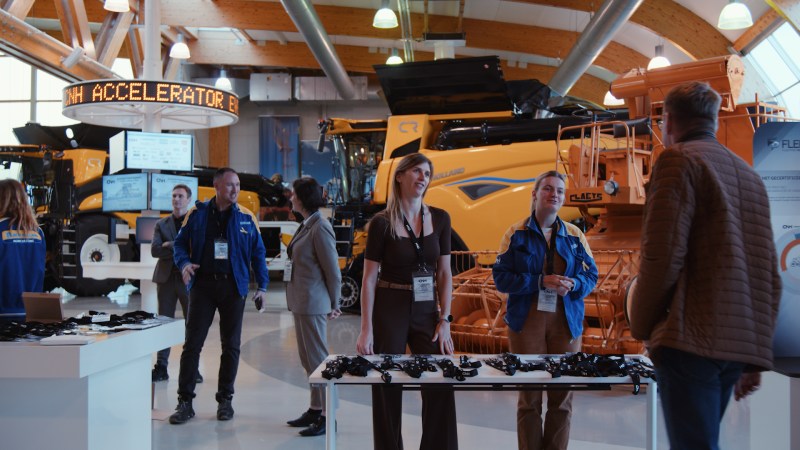
An initial Accelerator project, coordinated by Flanders Make, demonstrated what this model can deliver when manufacturers take the lead: six operational digital pilot lines, built by six pilot companies together with their R&D suppliers. The companies, Sirris and Flanders Make decided to invest in the continuity of this collaboration model.
Sirris now coordinates the next phase and is opening the ecosystem to a new group of companies through the Accelerator Learning Network. New pilot companies will take the lead in accelerating the adoption of digital technologies in their own production environments.
Conclusion
Moving from a promising plan to a valuable implementation in production requires more than technology alone. It requires disciplined collaboration, timely investment and the rapid development of relevant knowledge.
Our experience shows that successful scaling depends on getting the conditions right: starting from clear priorities, assessing business cases realistically, involving the right people and planning from the outset how new solutions will fit into the production process.
Sharing experiences with other manufacturers helps companies make these choices faster and with greater confidence. They can compare approaches, discuss implementation challenges and learn from solutions that have already been tested.
That is the approach behind the Accelerator Learning Network, which launches on 7 October 2026. Two regional groups of manufacturers, East and West, will meet for six sessions at participating production sites. They will exchange experiences and explore how digital solutions can be implemented and scaled in practice.
Join the Accelerator Learning Network
Would you like to exchange experiences with other manufacturers and discover how to successfully implement and scale digital technologies? Choose the learning network that best matches your region.
Where does your manufacturing company stand today?

The full data behind this article is available in the Smart Manufacturing Barometer 2026, a study by Sirris based on insights from more than 90 Flemish manufacturing companies.
Download the Smart Manufacturing Barometer


