

AI offers new possibilities for customisation, but a strong ERP core remains crucial.
Generative AI and coding assistants make it easier to develop your own applications and ERP add-ons. This changes the economic choice between standard software and customisation, but ERP is not disappearing. The core remains important, while the architecture, business model, and role of implementation partners are fundamentally changing.
AI makes building your own software more feasible
A recent Sirris case demonstrated just how significant the impact of AI-assisted software development can be. At Jonckheere Subcontracting, an outdated MES front end was rewritten with an AI coding tool in just three weeks. The original development would have taken more than a year.
Curana is going even further. The company developed its own applications around its ERP system, such as extensions for functions that its existing ERP did not support sufficiently. In addition to shop floor execution (MES), it developed add-ons for CRM, business development, and complaint management. A detailed planning module is also in the pipeline. Curana is now replacing its old ERP system. Its main priority is strong core functionality. These examples show how companies will increasingly build software themselves.
Read how Jonckheere Subcontracting accelerated its MES rollout with AI
The ERP core remains, while the outer layer becomes more flexible
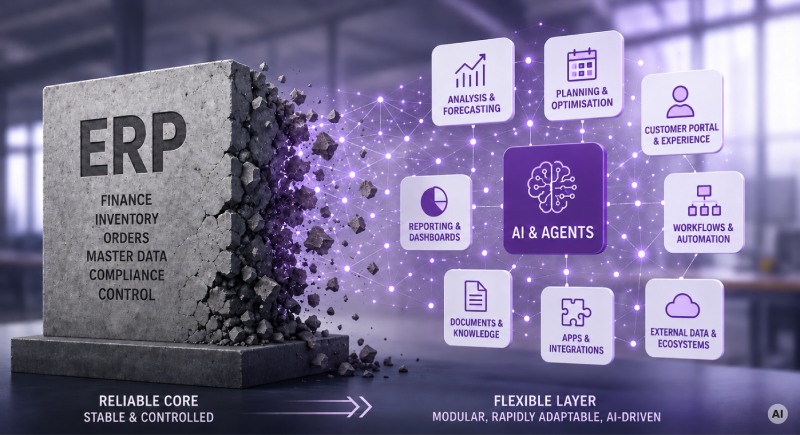
For now, ERP remains the place to manage accounting, inventory, orders, master data, authorisations, and audit trails. Longer-term planning also remains the backbone of ERP. This includes MPS, MRP, BOM explosion, and work preparation that generates planned production orders and purchase proposals. For these processes, consistency, control, and predictability matter more than maximum flexibility.
The architecture around that core is changing. New applications, workflows, and AI agents increasingly communicate with ERP systems through APIs and events. As a result, employees do not need to work directly in traditional ERP screens that often. An AI agent can gather information, flag exceptions, or prepare an action. The ERP system remains responsible for the final transaction and control.
Composable ERP enables targeted innovation
Gartner describes this evolution as composable ERP: ERP is no longer a fixed product, but an adaptive strategy. Companies build on a modern, integrated, and reliable ERP core. They then add modular applications, process automation, and AI agents step by step. The aim is not to replace the entire ERP system in one go. Instead, companies continuously add or adapt capabilities as their business needs change.
A useful design principle is:
Keep deterministic transactions in the core and probabilistic AI outside it.
For example, let AI gather information, prepare a payment proposal, or flag anomalies. Final posting, payment approval, segregation of duties, and audit logging are better kept within the ERP system. Central governance and monitoring remain essential. Without common governance, companies risk creating a fragmented landscape of agents and applications that are difficult to control.
Vibe coding lowers development costs, not total costs
AI tools clarify requirements, generate code, build interfaces, suggest tests, and produce documentation. This makes an initial working version cheaper and gets it delivered faster. BCG estimates that generative AI can currently reduce the total effort involved in large-scale ERP implementations by 20 to 40 per cent. But a prototype is not yet a reliable business application.
As soon as an add-on writes data back to a system, affects financial or operational decisions, or is used by several departments, the same questions arise as with conventional software: Who owns the applications? How are access rights managed? What happens after an ERP upgrade? This leads to a simple rule: prototype quickly, but industrialise deliberately.
Vibe coding is suitable for testing ideas, building temporary tools, or developing read-only applications. Production software involving payments, inventory valuation, employee data, planning, or quality control requires version control, code review, automated testing, logging, security checks, and a clear support model.
ERP vendors and implementation partners need to reinvent their models
When AI agents perform tasks without an employee logging directly into the ERP system, the number of users becomes a less effective basis for pricing. ERP vendors will therefore increasingly combine a basic subscription with usage charges for API calls, transactions, AI credits, or completed tasks.
Bain currently sees hybrid pricing models, combining traditional licences with usage- or value-based metrics, as the dominant intermediate step. (Bain) This does not mean ERP vendors will disappear. Their transaction data, data models, local compliance capabilities, authorisations, and audit functionality remain valuable. The risk for them is that they move into the background while another supplier controls the AI agent, user interface, and customer relationship.
For customers, vendor lock-in may therefore shift. It is no longer limited to customisation within the ERP core. The data model, integration layer, agent runtime, and hard-to-predict AI credits also make switching more difficult.
Implementation partners shift from coding to expertise
AI is also putting pressure on the traditional hourly billing model used by implementation partners. Routine coding, documentation, data mapping, and some testing are becoming faster. Their added value is shifting towards process design, integration architecture, data quality, cybersecurity, AI governance, change management, and industry-specific expertise.
Belgian expertise also remains relevant. Examples include accounting, VAT, Peppol, social legislation, and local business processes. Implementation partners are therefore not disappearing. Their role is shifting from programmer to architect, integrator, and management partner.
Should you postpone selecting a new ERP system?
In most cases, no. Since 1 January 2026, structured electronic invoices have been mandatory for transactions between Belgian VAT-registered businesses. An outdated ERP system therefore represents a growing rather than diminishing risk. Depending on their sector and application, companies must also take account of the GDPR, Belgium’s NIS2 law, and the European AI Act. This makes demonstrable security, logging, human oversight, and supplier management increasingly important.
Your approach mainly depends on your current situation:
- Is your ERP system no longer supported, difficult to secure, or dependent on a great deal of manual work? Start a selection or modernisation project now.
- Is your ERP core stable, supported, and easily accessible through APIs? Modernise around the existing core in phases and investigate where AI or specific add-ons provide real added value.
- Do not replace your ERP system solely because AI is evolving rapidly. Start with an architecture and data scan. This will give you a clearer view of future opportunities.
Five recommendations to prepare your ERP
- Keep your ERP core as standard as possible
Limit customisation in control-critical processes such as accounting, inventory, master data, and authorisations. A clean core reduces upgrade, security, and integration risks. - Build only what differentiates you
Buy standard solutions for common and legally defined processes. Configure limited company-specific variations. Build your own solutions where your process genuinely creates a competitive advantage. - Treat every production add-on as business software
Make sure it has an owner, repository, documentation, tests, security, monitoring, support, and a phase-out plan. This also applies when AI generated most of the code. - Select based on openness and total cost
In an ERP RFP, ask about supported APIs, events, versioning, data exports, exit conditions, AI models, subprocessors, API charges, and AI credits. Look beyond the price per user. - Take a step-by-step approach
Start with low-risk applications such as search, reporting, document proposals, or read-only assistants. Only move on to transactions when quality, security, human oversight, and auditability are demonstrably under control.
Don’t wait, but rethink ERP
The future is unlikely to be a fully monolithic ERP system. Nor will it be an uncontrolled collection of AI apps. The most robust approach combines a reliable transaction core with a managed integration and agent layer. When selecting an ERP system, stop asking only: which package can replicate all our current requirements? Instead, focus on this question:
Which core do we want to rely on for the long term and which processes do we want to adapt quickly outside that core?
The advice for companies is clear: do not wait for the perfect AI-native ERP system. Map your processes, data, customisations, and integrations now. Buy the standard core, keep it clean, and build only what differentiates your business. Once AI-generated code enters production, treat it with the same discipline as any other business-critical software.
Summary
AI makes ERP customisation faster and more accessible, but it does not replace the ERP core. The future lies in a reliable standard core surrounded by flexible applications. Companies should base their ERP choices on open integrations, governance, total cost, and room for controlled innovation.
Conclusion
Do not wait for the perfect AI-native ERP system. Map your processes, data, customisations, and integrations now. Choose a reliable standard core and keep it as clean as possible. Build only applications that create real added value. Always treat AI-generated code in production as fully fledged business software.
Want to make your ERP architecture future-ready?
Sirris helps you take a critical look at your ERP landscape, integrations, and customisations. Together, we examine where standard software is sufficient and where AI or targeted applications can add value. This allows you to build a manageable, future-ready digital architecture step by step.