

What does it cost to prevent the environmental impact of products? The eco-cost method enables you to calculate this eco-impact. While this approach may seem simplistic and presents certain challenges, it offers concrete tools to support design decisions. In this article, we explain what eco-costs are, when to use them, and how they can be translated into practical design checklists. We illustrate this with an industrial case study.
What is eco-cost and when is it useful?
The eco-cost of a product is a measure of its environmental burden, expressed in euros. In this sense, the method is very similar to those used in the Ecolizer (OVAM), where it is expressed in eco points. It represents the cost required to prevent the environmental damage caused by the product through preventive measures. The higher the eco-cost, the greater the environmental impact.
This approach is not an exact science. It involves simplifications and approximations of real processes. However, its simplicity and visual applicability make it valuable. You can use it from the early stages of product development, when many decisions are made that determine the final environmental impact. For instance, if you want to compare two materials, this tool is ideal.
How does it work?
The eco-costs of various materials, processes, transport, energy, and end-of-life scenarios are available per unit. These parameters are input into a model that translates the impact into eco-costs in euros. This allows you to quickly identify major impact factors and potential optimizations. Unlike a full LCA, which requires significant time and data, this tool enables quick comparisons during the design phase. More information about the methodology and everything you need to get started can be found at ecocostsvalue.com.
The real challenge: integration into the design process
The calculation itself is not the goal but a means to learn and adjust. The insights from the eco-cost analysis become truly valuable when translated into targeted design actions. We have developed a methodology where the analysis results are converted into practical design checklists, specifically tailored to the product type under study.
Such a checklist poses targeted questions, such as:
- Can components be repositioned to avoid waste?
- Can an alternative material with lower eco-cost fulfill the same function?
- Are there alternative processes with lower energy consumption?
The checklist is a tangible tool for design teams, helping them to concretely incorporate ecological considerations into the decision-making process.
Case: electric hoist
A company contacted us about designing an electric hoist. Based on the data on the main materials and their processing, logistics, product use, including maintenance, and product disposal, we obtain the following picture:
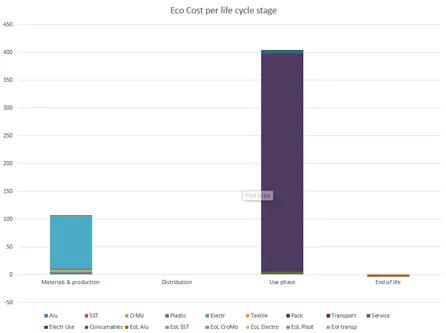
There is only a very small impact of the materials and their weight on energy consumption in this case. So, if we now remove electrical consumption from the equation, we get a better picture on the impact of materials.

In this case the impact of electronics emerges as dominant. For the company concerned, the circular design strategy aimed at parts recovery ('parts harvesting'), especially for the electronic modules, is a major asset. The economic drivers (availability and price) and the ecological drivers reinforce each other in this case.
In the subsequent stages of the design process, attention is paid to modularity and upgradeability ('upgradeability') of the electronic modules, among others. The framework conditions (standardised interfaces and tools, etc.) can also be examined to create a 'circular design checklist' on this basis.
Getting started with eco-cost and circular design
Do you want to consider the environmental impact of your products during the design phase? Then the eco-cost method is a practical starting point. The method is:
- Quick to apply, without heavy data input
- Visual and understandable for design teams
- Ideal for initiating discussions between design, procurement, production, and marketing
For those who want to go further, the method can also serve as a preparation for a full Life Cycle Assessment (LCA), providing a detailed view of the environmental impact throughout the entire lifecycle.
Assess the environmental impact of your product


