

Visualise your circular ambition and take achievable steps
What do you want to achieve as a company with ReX activities? The answer starts with your strengths, assets and capabilities. For social enterprises, this often means labour-intensive processes and meaningful employment. For manufacturing companies, it relates to product knowledge, market insight and technological expertise.
When ReX projects align with your goals and core activities, employees experience their work as more meaningful and strategic. Describe your desired future vision. This gives shape to ambition and makes action possible. Reuse, repair and refurbishing open the door to meaningful, stable and future-oriented activities in which your company can take on different roles in the value chain.
Every social enterprise has its own strengths and context. This framework helps you take the most relevant steps for your situation. We have bundled all insights into one publication.
Download the full publication here
ReX as a lever for meaningful growth
More and more social enterprises show that small, feasible ReX initiatives make a real difference for employees, customers and society. At the same time, manufacturing companies discover that these initiatives create new value, for example through longer product life cycles, additional services or circular value propositions.
You do not need to wait for others. Take initiative yourself and explore new ReX paths, independently or together with partners. Complementarity between partners forms a strong lever.
Ambition driving action
Great ambitions start with concrete first steps. Describe your desired scenario. This creates attraction and movement from your current situation. The potential added value puts uncertainties into perspective. It motivates teams to learn, experiment and collaborate. A clearly formulated change ambition is therefore crucial, both internally and towards partners.
Explore your ReX ambition level
Your organisation fulfils a role towards customers. This role determines which activities you take on yourself and which you organise with others.
For social enterprises, this may range from operational ReX processes such as inspection and repair to co-creation in new activities such as upgrading and refurbishing. For manufacturing companies, this ranges from product and service sales upon customer request to proactive services such as take-back and remanufacturing, and roles in the value chain such as coordination, logistics or matchmaking.
There are no right or wrong roles. Choose what fits your ambition, resources and future vision. A schematic overview from a social enterprise perspective helps you understand the intended roles in relation to each other. It triggers ideas, stimulates internal dialogue and makes thinking concrete.

Importance of proactivity
The stronger the ambition for co-creation and entrepreneurship, the more proactivity is required. This applies to organisations executing ReX activities as well as those initiating or coordinating them. Be clear about the impact of your ambition and the required effort, internally and with partners.
Step 1: choose the scope
Start from what already exists. Select ideas for which you have experience, knowledge and skills. Use the “strengths” exercise to identify ReX opportunities. Make your objective concrete:
- Specific product or product group: which current products with ReX potential or similar product groups qualify
- Processes with the highest potential: which processes align with ReX and match your strengths and capacity
- Customers or customer types: which customers already invest in reuse, repair or upgrade and where you see new potential
- Specific region: which locations offer strengths and partners and where existing ReX activities can be reinforced
Step 2: define the desire for change
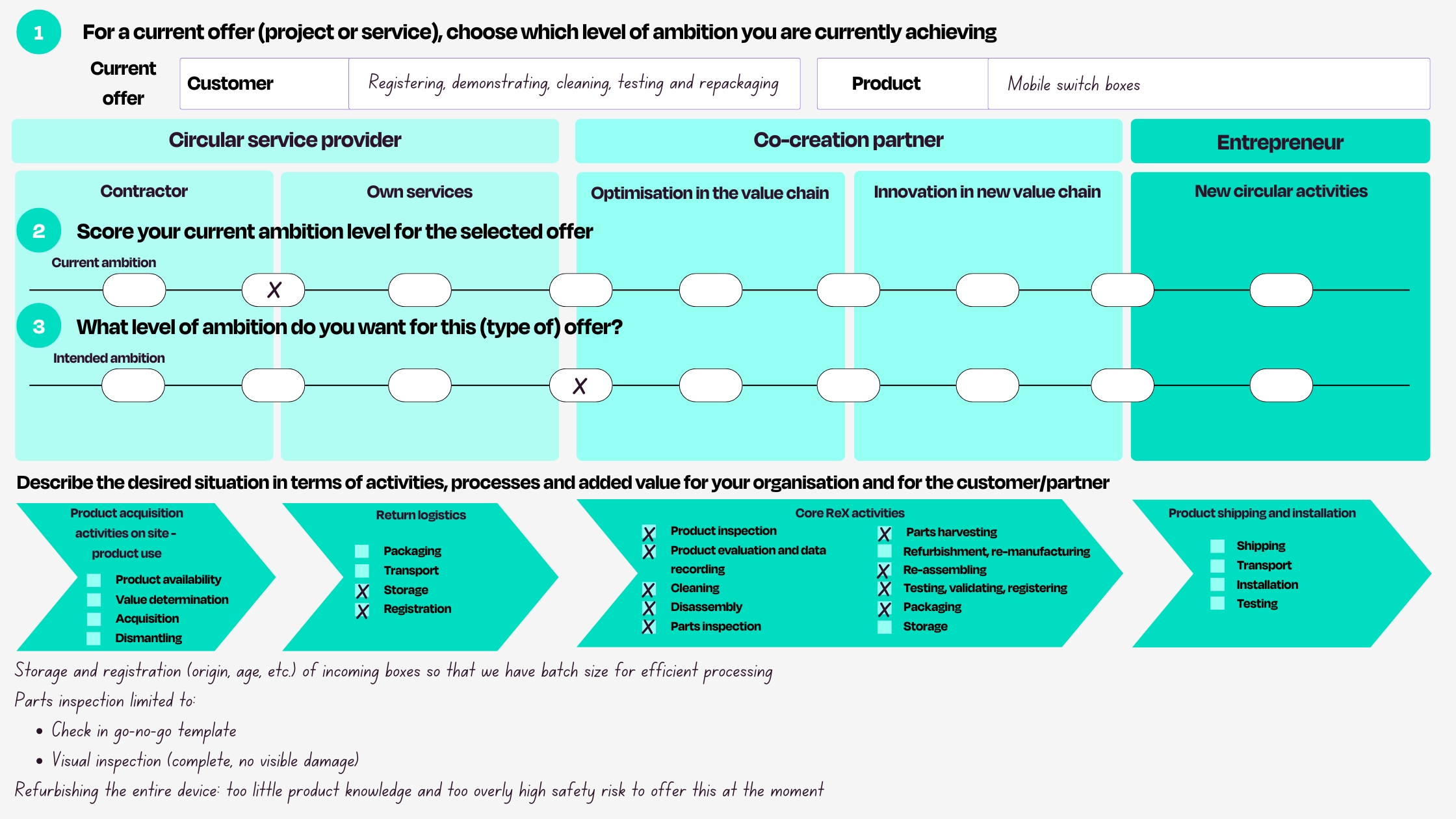
Sketch your future vision within the chosen scope. What does the new situation look like if everything succeeds? Which role do you take and which activities change?
Describe the intended situation as a storyline. Work in a small team and avoid excessive detail or early cost calculations. Use a simple scheme to structure the exercise. List processes, resources and their contribution to ReX:
- Processes and activities: storage, registration and digitisation, inspection, cleaning, dismantling, selection for reuse, reassembly with testing, packaging and shipment
- Resources: storage space, testing and inspection equipment, up-to-date data management and analysis tools
- Processes and activities: storage, registration and digitalisation, inspection, cleaning, dismantling, selection for reuse, reassembly and testing, packaging and shipping
- Resources: storage space, testing and inspection equipment, up-to-date data management and analytical tools
Step 3: rank preconditions
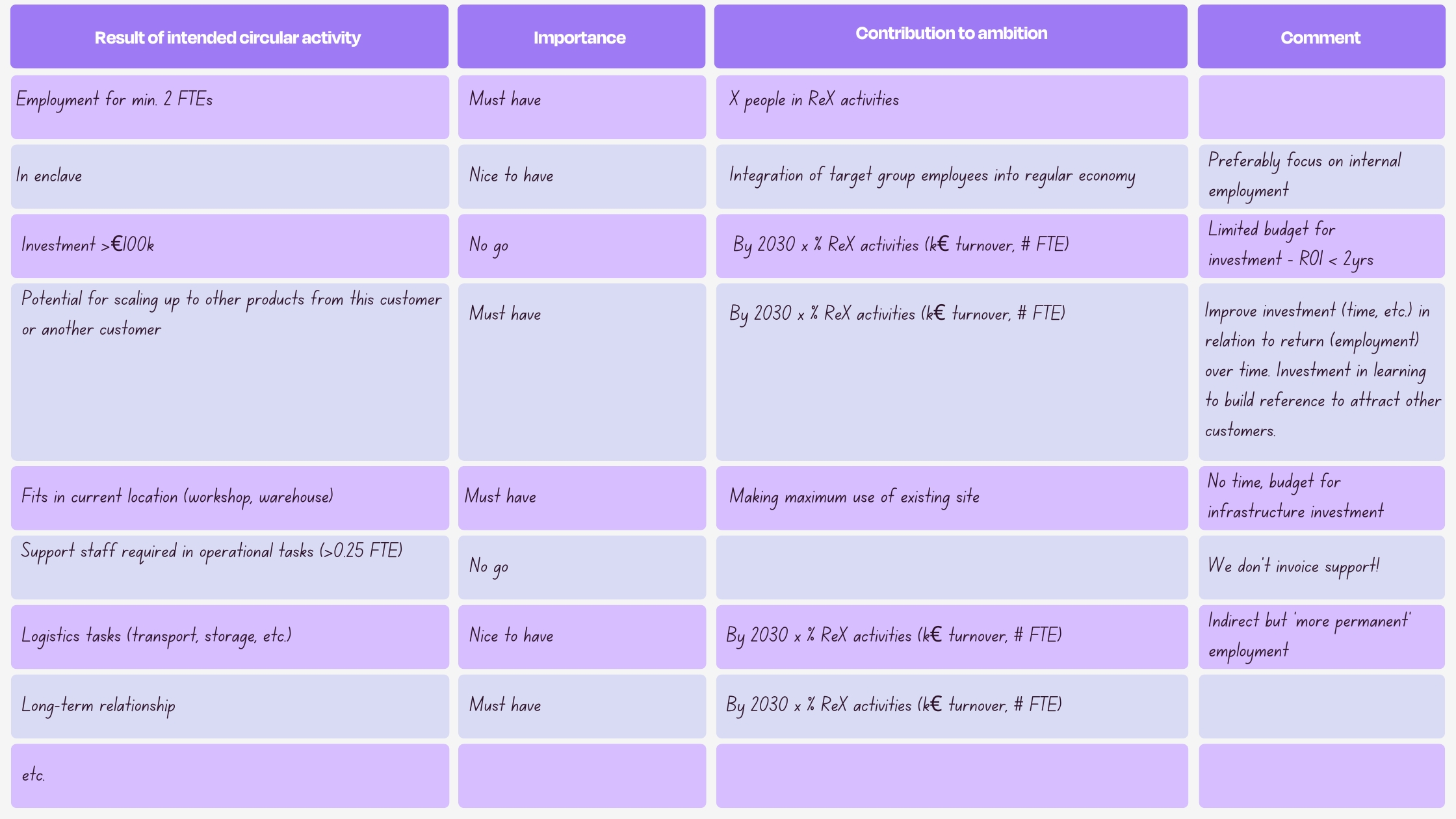
Not everything is equally important. Rank outcomes as essential, desirable or unwanted. Link them to your ReX ambition. Consider employment, collaboration, investment willingness, technology and processes, and the scope of activities. Clearly define how much learning investment you are willing to make and within which limits, taking into account operational feasibility and strategic added value.
Conclusion
By clearly defining your ReX ambition, you make circular growth concrete and achievable. You translate vision into focused choices that guide your organisation. A clear future perspective builds confidence and strengthens collaboration. In this way, ReX becomes more than an experiment. It becomes a structural lever for sustainable, inclusive and future-proof value creation.
Summary
By visualising your ReX ambition, choosing a scope and prioritising conditions, you move from intention to concrete action. Knowing what you want to achieve helps partners design effective collaboration. You speak the same language as partners and customers. This accelerates decision-making and increases the chances of circular growth, both economic and societal.
A look ahead at the series
After exploring your ReX ambition, the next step is collaboration. By joining forces with like-minded partners, social enterprises and manufacturing companies increase both impact and success. The next article explains how to align goals and why co-creation goes beyond traditional collaboration. It is the key to shared progress.
Discover the other articles in the ReX series:
- Discover the full ReX series
- Part 1: ReX activities for sheltered workshops: opportunities and collaboration
- Part 2: room for manoeuvre for ReX Initiatives in sheltered workshops
- Part 3: the driving forces for ReX Initiatives
- Part 4: your strengths with regard to ReX initiatives
- Part 6: co-creation for ReX initiatives
- Part 7: a solid business case for ReX collaboration
- Part 8: one ReX revenue model, multiple business cases
- Part 9: the motivations that drives ReX forward
- Part 10: constraints that make ReX stronger
- Part 11: strengths as a Lever for ReX
Discover the Remanumaat project
Would you like to learn more about this topic and how collaboration within ReX strategies works?
Living Lab Circular Economy Remanumaat (VNS.2023.0113) with financial support from VLAIO.


