

A breakthrough in passive ice prevention
Ice accumulation on exposed structures such as aircraft wings, wind turbine blades, pipelines, or offshore platforms remains a persistent challenge in cold environments. Traditional de-icing methods, based on heating or chemical agents, are energy-intensive, costly, and environmentally problematic. At Sirris, we explore femtosecond laser texturing to design surfaces that naturally delay or prevent ice formation.
Understanding how ice forms
Ice forms when water droplets freeze or vapor condenses. To prevent it, we first need to understand wettability how water interacts with a surface.
A droplet can either spread (hydrophilic), bead up (hydrophobic), or barely touch the surface (superhydrophobic). Two states explain these behaviors:
- Wenzel state: the liquid wets the rough surface
- Cassie–Baxter state: the liquid rests partly on air pockets, limiting contact
Achieving a stable Cassie–Baxter state is key for anti-icing. It lets droplets roll off quickly, reducing the time water stays before freezing.

When water vapor becomes the enemy
Even a superhydrophobic surface is not automatically icephobic. Ice can form from vapor through frost or condensation. Here, another factor matters: ice adhesion. The weaker the bond between ice and the surface, the easier natural forces like wind or vibration can remove it.
At Sirris, we combine femtosecond laser texturing with surface chemistry to tackle both problems. The laser defines micro- and nano-structures, such as pillars or Laser-Induced Periodic Surface Structures (LIPSS), while coatings fine-tune surface energy and freezing behavior. This synergy reduces ice nucleation and limits adhesion once freezing occurs.
Testing in real cold conditions
To evaluate how laser-textured surfaces perform against ice, Sirris launched a series of experiments with the OWI Lab (Antwerp) using its advanced climatic chamber. The goal was to measure how different surface designs influence ice nucleation and adhesion under realistic, controlled conditions.
The test campaign included several types of samples:
- Untreated reference surfaces
- Purely coated surfaces
- Micro-textured samples
- Nano-textured (LIPSS) samples
- Hybrid textures combining laser and coating
During controlled sub-zero tests, the samples were exposed to supercooled droplets and repeated frost formation cycles. Observations showed that textured and hybrid surfaces delayed frost spread longer than untreated or coated references. Some designs also showed slower freezing and weaker ice adhesion, suggesting that micro- and nano-scale structuring and its combination with chemical modification is beneficial.
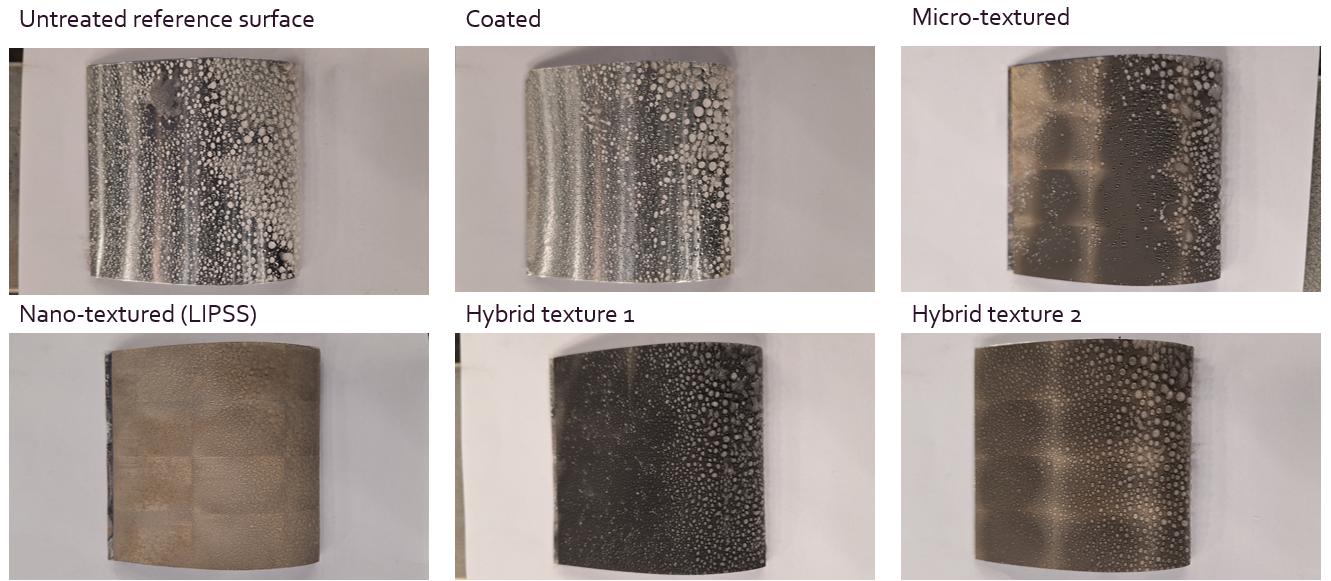
Although results are still preliminary, trends confirm theory: laser-induced topography and its combination with chemical control can significantly delay freezing and ease ice removal.
From lab to industrial scale
The implications reach far beyond the lab. Laser-textured surfaces could enhance safety and efficiency in:
- Aerospace: preventing wing icing
- Wind energy: keeping blades free from frost
- Transport: securing critical infrastructure
- Offshore operations: reducing maintenance in harsh weather
Sirris aims to scale this technology for industrial use, ensuring precision, repeatability, and cost-efficiency. Our long-term goal is to integrate passive anti-icing directly into components, improving energy efficiency and extending service life.
Through our partnership with OWI Lab, we bridge scientific innovation and engineering practice, bringing reliable, passive anti-icing closer to industrial reality.

Summary
Femtosecond laser texturing enables surfaces that resist icing naturally. By adjusting micro- and nano-patterns and combining them with coatings, Sirris develops sustainable alternatives to energy-intensive de-icing systems. Early tests confirm strong potential for industrial applications.
Conclusion
The fight against ice is entering a new phase. With femtosecond laser texturing, Sirris demonstrates that passive, durable anti-icing is possible. Continued research and testing will refine this technology turning complex science into practical and scalable innovation for cold-environment industries.
This article was published as part of the BBBC project, with support of the Belgian FPS Economy.
Discover the FEMTOFUNC project
This case study is part of the broader FEMTOFUNC research on biomimetic surface functionality.
Would you like to explore how femtosecond laser texturing can enhance your products’ performance in cold conditions?
Contact our surface engineering experts to discuss tailored anti-icing solutions for your application.


