

How can low volumes, durability and production costs be reconciled?
In defence avionics, producing alphanumeric keypads in small batches presents specific technical and economic challenges. Key configurations are highly customised, whilst the requirements for resistance to wear and tear and environmental conditions are high. However, the most robust technologies require investments that are difficult to recoup when production volumes are small. How do you strike the right balance between technical performance and economic viability?
Avionics keyboards: a demanding case
In a highly specialised sector such as defence avionics, the design and manufacture of alphanumeric keypads present challenges that are very different from those encountered in high-volume consumer markets.
These applications require customised key configurations, often a limited number of keys, and must meet strict requirements in terms of wear resistance, reliability and resistance to environmental conditions.
Furthermore, production volumes are small. They often range from a few dozen to a few hundred units and only very rarely reach a thousand items. It is this combination of high levels of customisation, small production volumes and high performance requirements that makes it difficult to choose the right key manufacturing technology.
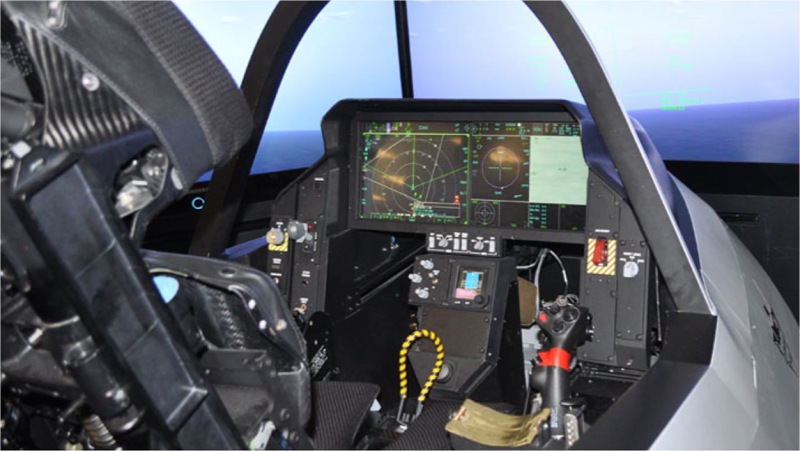
Strict performance requirements for defence avionics (F-35 cockpit).
Overmoulding: robust, but expensive for small production runs
Two-shot injection moulding is the industry standard for producing durable backlit keyboard keys. The process combines two materials: a translucent polymer forms the backlit character, whilst an opaque polymer makes up the body of the key.
The character is thus embedded within the material, unlike a simple surface marking, which provides excellent wear resistance, high durability and good backlighting performance.
In defence avionics, the main constraint is financial. The high cost of complex tooling is justified in mass production, but becomes difficult to recoup when producing only a few dozen or a few hundred items. The unit cost can therefore become prohibitive, despite the technical advantages of the process.
Cheaper but less durable alternatives
For small-volume production, manufacturers often consider less expensive options, such as textured keys combined with laser marking or printing. These technologies require significantly lower initial investment and offer greater flexibility when it comes to customising the characters. However, they suffer from one major drawback: insufficient long-term durability and premature wear of the keys.
In demanding operational environments, repeated use, abrasion and exposure to harsh conditions can lead to premature deterioration of printed or laser-engraved characters. This wear and tear may affect the legibility and functionality of the keys. For critical equipment where reliability and durability are essential, this deterioration is unacceptable.
Between high-performance overmoulding, which is difficult to make cost-effective, and more accessible but less durable processes, there is therefore a need for an intermediate solution.
Towards an intermediate technology
The ideal technology would combine a moderate investment in tooling with high durability, ensuring resistance to wear whilst remaining economically viable for small production runs. Meeting this challenge is essential for the next generation of robust, customisable and cost-effective human-machine interfaces in defence avionics.
To identify the most suitable technology, it is therefore necessary to carry out a more detailed comparison of the business models of the various processes.
Tooling costs and unit costs
The manufacture of backlit keys using overmoulding (two-stage injection moulding) is a highly efficient production technology. However, it requires significant capital investment. Its economic viability depends heavily on production volumes.
The main cost driver is tooling: complex multi-cavity moulds, fitted with sophisticated mechanisms, are required to align and mould the two materials with precision. Depending on the complexity and production capacity, their cost usually ranges from €150,000 to €500,000. Alternative manufacturing processes (laser engraving with surface coating or pad printing) require much simpler tooling, costing between €20,000 and €80,000.
On the other hand, the recurring cost per unit is lower with overmoulding. Once the tooling costs have been recouped, the production cost per key is between €0.05 and €0.20, thanks to process integration and the elimination of secondary operations. Although alternative methods require a lower initial investment, they result in significantly higher unit costs, usually between €0.10 and €0.40. This difference is due to the additional steps involved in painting, laser engraving or printing.
Calculate the break-even point
The decision therefore hinges on a trade-off between high fixed costs and lower variable costs. Let’s take a keyboard comprising around 100 keys, with a cost saving due to overmoulding of around €0.10 per key. This works out at around €10 per keyboard.
The break-even point is calculated by dividing the additional investment in tooling by the savings achieved per unit. If the additional tooling costs associated with overmoulding amount to €250,000, the break-even point is around 25,000 keypads.
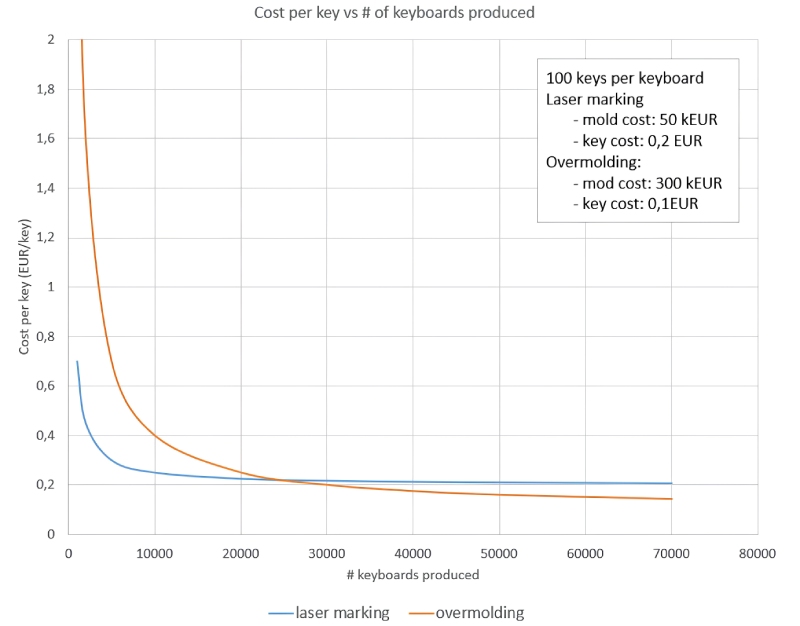
Cost per key, depending on the number of keyboards produced. Comparison: laser marking and overmoulding.
Below this volume, alternative technologies are usually more cost-effective. Once this threshold is exceeded, investment in overmoulding becomes economically viable.
A threshold that varies greatly depending on the context
In practice, this threshold varies considerably depending on a number of factors. In favourable scenarios, such as high-end products with high profit margins, a large number of backlit keys or optimised multi-cavity tooling, it can fall as low as 10,000 units.
Conversely, it may exceed 100,000 units for compact keyboards with fewer keys, smaller cost differentials or a wide variety of products requiring multiple tooling set-ups.
Industry benchmarks provide some indication of the scale involved:
- Industrial equipment and human-machine interfaces (HMIs): overmoulding feasible for between 20,000 and 50,000 keyboards
- Consumer electronics (standard keyboards, gaming keyboards): between 50,000 and 200,000 units
- Automotive industry: overmoulding is justified for runs of over 100,000 units and often well in excess of 500,000
A rule of thumb in engineering puts the break-even point at between 30,000 and 100,000 units, depending on the number of keys, the cost structure and the complexity of the tooling. For quantities of less than 20,000 units, it is usually advisable to opt for other methods. The range of 30,000 to 80,000 units is a grey area that requires a detailed cost analysis. When the number of units exceeds 100,000, overmoulding is often the best method, both in economic terms and as regards quality.
Other factors play a part in the decision
Beyond the break-even point, other factors come into play. Starting with the management of product variants. For example, different keyboard layouts (AZERTY or QWERTY) may require several versions of the tooling. It is also important to take into account the maintenance of complex moulds, the risk of product obsolescence, and product quality and reliability requirements. In such cases, overmoulding offers a significant advantage: its wear resistance can reduce warranty and replacement costs over the entire life cycle.
In conclusion, whilst overmoulding remains the technologically superior method for backlit keys, its economic viability depends heavily on the scale of production. For most applications, a reliable estimate puts this threshold at between 30,000 and 100,000 keyboards. However, the optimal choice depends on the product’s characteristics, the planned volumes and all the project's technical, economic and strategic constraints.
Which process is best suited to your production volumes?
Each application involves its own specific constraints in terms of volume, durability and customisation. Sirris’s experts can work with you to assess the technologies relevant to your product.
Sirris's ACE4ACES process
Typical volumes for defence avionics fall outside the range where traditional overmoulding is easily cost-effective. Moreover, their requirements exceed what some surface marking solutions can offer.
As part of the ACE4ACES project, funded by the DEFRA (Defence-Related Research Action) programme, Sirris looked into an intermediate process that meets these dual requirements.
It’s a technique that combines injection moulding, 3D printing and machining. It enables the production of robust keys that are virtually wear-free – at low cost and within very short lead times. This process is particularly well suited to limited runs, ranging from ten to a few hundred units, or even a few thousand per batch. It also offers the flexibility needed to customise the characters.
A low-cost keyboard prototype designed for small-volume production has been developed as part of the ACE4ACES project, in collaboration with Scioteq BV, Swave BV, VoxelSensors, Apixa, Thales Belgium and dotOcean.
This approach is aimed at an intermediate area of application, involving volumes that are too small to justify the use of complex tooling, and durability requirements that are too high for certain surface marking solutions.
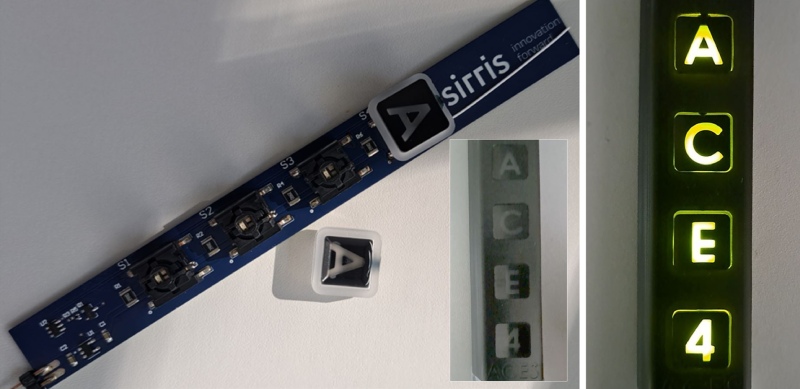
A prototype keyboard for low-volume production, featuring keys with extremely high wear resistance, developed by Sirris as part of the ACE4ACES project.
Potential beyond defence
Although developed to meet the requirements of defence avionics, this approach can also be incorporated into small-scale civil production. The same constraints are particularly evident in certain types of medical or industrial equipment: highly customised interfaces, small production runs and wear resistance requirements. The process studied in ACE4ACES therefore also opens up new possibilities for these applications.
The choice between overmoulding, alternative processes and hybrid approaches remains, above all, a question of volume and application requirements. There is no one-size-fits-all solution; a balance must be struck on a project-by-project basis.
Are you developing a robust interface for small-batch production?
Are you looking to combine customisation, durability and control over production costs?
Please contact Carl Emmerechts to discuss your application.
Discover the ACE4ACES project
ACE4ACES is exploring new technologies for multimodal cockpit interfaces, from advanced displays and eye and gesture tracking to AI-supported communication. Discover how Sirris and its partners are developing interfaces for future combat aircraft.


