

‘Bring a production challenge and leave with concrete next steps’
Discovering new technology is easy. Successfully implementing it on your shop floor is another matter. At SMAFACC 2026, you will not only see what automation, digitalisation, and AI can do. More importantly, you will hear directly from manufacturing companies about what really works. Peter Ten Haaf, Program Manager Manufacturing Systems and Technologies at Sirris, explains why this year's event is particularly interesting for Flemish manufacturers.
What is SMAFACC?
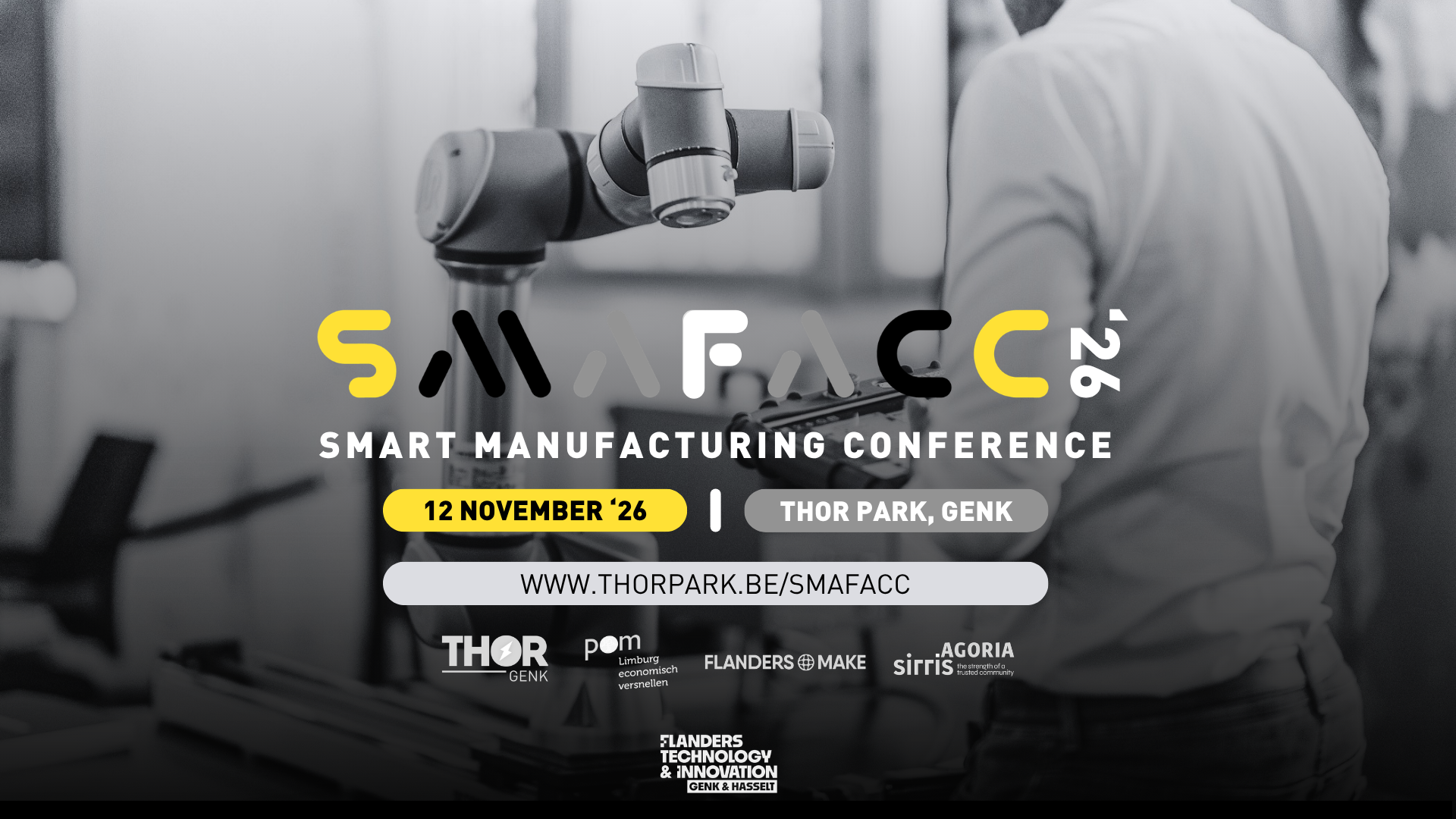
On 12 November 2026, SMAFACC, the annual Smart Manufacturing conference, will bring together manufacturing companies and technology experts at Thor Central in Genk. The programme focuses on smart manufacturing, automation, and digitalisation. But don't expect a conventional technology fair full of impressive promises.
‘You'll meet companies that have actually implemented technology. They'll tell you what worked, but also what didn't go as planned. The latter is just as valuable.’
Visitors will gain insights from different perspectives. Technology companies will demonstrate solutions in areas including automation, digitalisation, and AI. Manufacturing companies will also share their own practical experiences. This combination is what makes SMAFACC interesting. You see a technology and then hear how it performs in practice.
SMAFACC is organised by Thor Park, POM Limburg, Agoria, Flanders Make, and Sirris. The 2026 edition is also part of the Flanders Technology & Innovation festival.
What exactly can manufacturers expect to see?
Above all, applications that work, explained by the people who made them work. According to Peter, that is where the greatest added value lies. A demonstration shows what is technically possible. A real-world case study explains what it took to get there.
Assessing technology based on marketing materials remains difficult. Everything works perfectly in an ideal demonstration environment. Your own factory is not an ideal demonstration environment. That is why first-hand accounts are so important. Companies discuss their approach and results. They also talk about the obstacles they encountered along the way.
Some of these are technical problems. But the biggest challenges often lie elsewhere. Data must be usable. Employees need to be on board. Processes sometimes need to change. These are precisely the issues that can derail an otherwise promising technology project.
The case studies presented at SMAFACC reflect this broader perspective. One example focuses on the digital transformation of Zweko Optics. Its fragmented environment of Excel spreadsheets, PDFs, emails, and different systems had become an obstacle to further growth. The chosen approach therefore goes beyond software. It also covers processes, planning, stock management, and future automation.
Another case study, from Aerotrim, starts with a five-year vision for production and growth. Technology is not the only priority. Considerable attention is also given to securing support from employees, managers, and senior management.
‘These are stories that other manufacturers can learn from. You don't just hear what someone bought. You understand why certain decisions were made.’
What's different about SMAFACC this year?
Previous editions were particularly strong on inspiration. This year's event also aims to bring the next step within reach. According to Peter, one important difference is the Groeilab. Here, you can speak directly with organisations that support innovation projects. These include research institutions, sector organisations, and organisations specialising in funding, talent, and internationalisation.
In the past, you might have gone home with a good idea. Then the homework began. Who could provide technical support? Which companies were working on the same problem? What support was available? This year, you can explore several of these questions on the same day.
Suppose you are considering a specific automation project. You can discuss its technical feasibility with a knowledge partner. At the same time, you can connect with your network. You can then explore which forms of support best suit your project.
According to Peter, this changes the role of the event. ‘SMAFACC remains a place for inspiration. But it can now also become the starting point for a concrete innovation project.’
Why is SMAFACC important for Flemish manufacturers?
The challenges are familiar. Finding skilled employees remains difficult. Costs are under pressure. Making operations more sustainable requires investment. Meanwhile, digital technology and AI continue to evolve rapidly. Yet companies do not always lack solutions.
The problem is often that support is fragmented. Expertise exists. Networks exist. Funding opportunities exist. But they are spread across different organisations. This is already a challenge for large companies. For smaller manufacturers, the search is even more demanding. ‘Think of an SME with twenty employees. It usually doesn't have an innovation manager who is constantly researching technologies and support programmes.’
This is where an event such as SMAFACC helps you save time. One good conversation can clarify which technology is relevant. A second can put you in touch with the right expert. A third might reveal that an investment is feasible after all.
A strong manufacturing industry is not built simply by one company suddenly making an enormous leap forward. The aim is to enable a broad range of companies to keep innovating. To achieve that, innovation must become accessible.
What you'll learn at SMAFACC 2026
1. What really works?
Listen to companies that have already tried it. The bottlenecks they encountered are often more valuable than a flawless demonstration.
2. What does implementation really involve?
Technology is rarely the whole story. Data, processes, and people all help determine the outcome.
3. Who do you need?
You don't have to tackle an innovation project alone. Use SMAFACC to identify the partners who can help accelerate your next step.
How to get the most out of your visit
Come with a question written down, but not a broad one such as: what could we do with AI? Instead, choose a specific problem from your production environment. Where are you losing time today? Which task is still too labour-intensive? Where are quality losses occurring?
‘With a question like that, your conversations suddenly become very different. You're no longer simply walking past stands. You can assess every technology and every expert against your own situation.’
Three more practical recommendations:
- Don't miss the real-world case studies
- Make time for spontaneous conversations
- Bring an operator or technician with you
Peter believes the last point is particularly underestimated. ‘Someone from the shop floor looks at technology differently. An operator can often spot within minutes where a solution will run into problems in your production environment.’
So don't fill every slot in your SMAFACC schedule. The best conversations at events like this are rarely all planned in advance. Leave time to approach someone after a presentation. Or spend a little longer at an interesting demonstration.
From exploring possibilities to making progress
SMAFACC 2026 aims to be more than a showcase for new technology. The programme combines inspiration, practical experience, and access to support. This makes the event particularly interesting for companies already facing a specific challenge.
‘You don't need to have a fully developed project,’ Peter concludes. ‘But do bring a real problem. That way, in just one day, you can discover what's possible, what the pitfalls are, and who can help you move forward.’
In summary
SMAFACC 2026 brings technology, practical experience, and innovation partners together in one place. The greatest value is not necessarily in seeing as many solutions as possible. Come with a specific production challenge. Use it as your starting point to assess technologies, experiences, and potential partners in a focused way.
Discover SMAFACC and get inspired
Come to Thor Central at Thor Park in Genk on Thursday 12 November 2026, from 9.00 am to 6.00 pm. Discover inspiring keynote presentations, real-world case studies, interactive breakout sessions, and technology booths. Exchange experiences with peers, explore new opportunities in the Groeilab, and discover how you can accelerate innovation in your company.
Explore the programme and register
This conference will be held in Dutch.
Conclusion
You don't need to arrive at SMAFACC with a fully developed innovation project. A specific production challenge is enough. By combining the experiences of other manufacturers with technology and the right expertise, you can identify the next step that makes sense for your company and is realistically achievable.


