An innovative medical trolley shows how smart product design contributes to circular healthcare
Making healthcare more sustainable doesn't have to be complicated. Recurite proves the point. This innovative medical trolley for intensive care units makes waste sorting easier by combining ease of use with circular principles. Recurite demonstrates how collaboration and smart product design contribute to more sustainable healthcare. It is an inspiring example of the ambition behind the Design for Sustainable Medical Devices (D4SMD) project, which aims to make medical device design more sustainable.
Smart waste sorting starts at the bedside
A waste audit in the intensive care unit at ZAS Middelheim revealed that as much as 46% of waste was incorrectly sorted. This wasn't because healthcare staff were unwilling to sort waste properly, but because their working environment didn't provide enough support.
Waste bins aren't always in the right place, and clear visual guidance is often lacking. As a result, recyclable materials end up being incinerated, causing unnecessary environmental impact and costs.
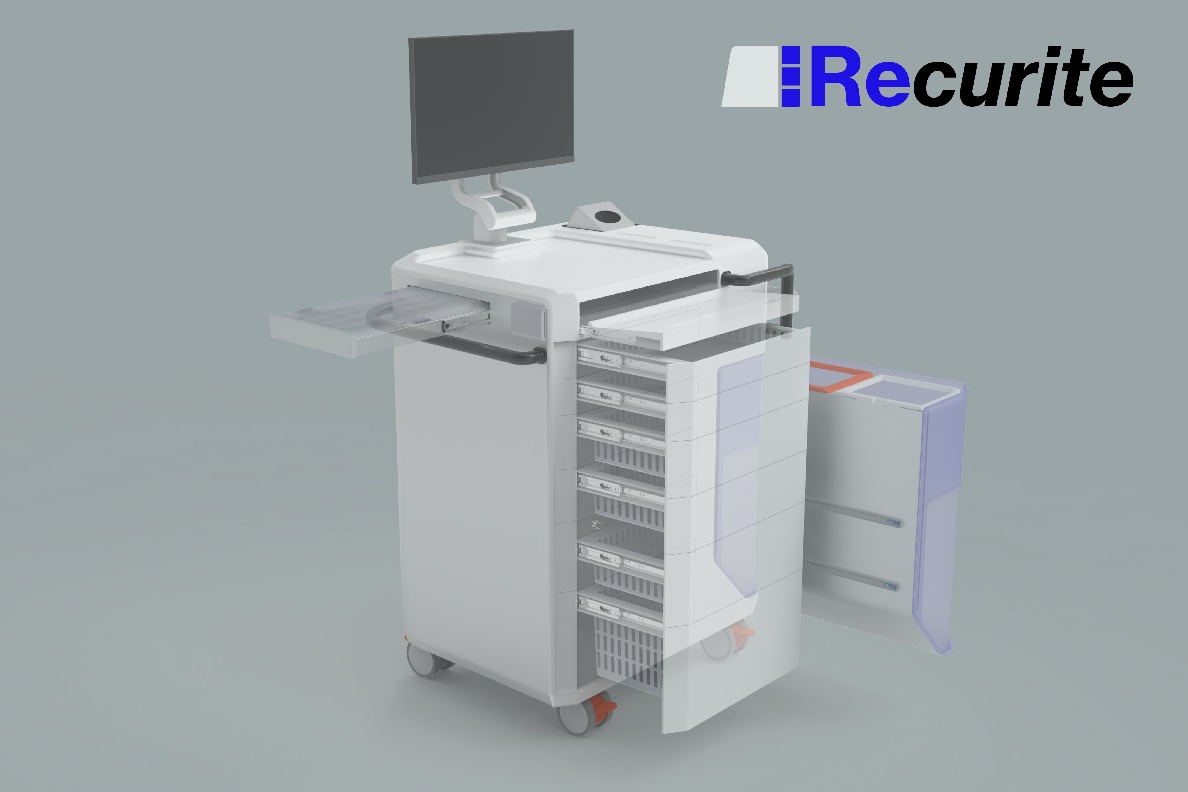
To address this problem, Quinten Hensbergen, a master's student in Product Development at the University of Antwerp, developed Recurite. This ergonomic, modular medical trolley integrates waste sorting directly where waste is generated: at the patient's bedside.
The trolley combines configurable storage space for medical supplies with separate compartments for PMD (plastic packaging, metal packaging, and drinks cartons), cardboard, and non-hazardous medical waste. Intuitive colour coding, clear labels, and ergonomic operation make correct waste sorting the easiest option. An additional 30-litre compartment also provides space for future circular initiatives.
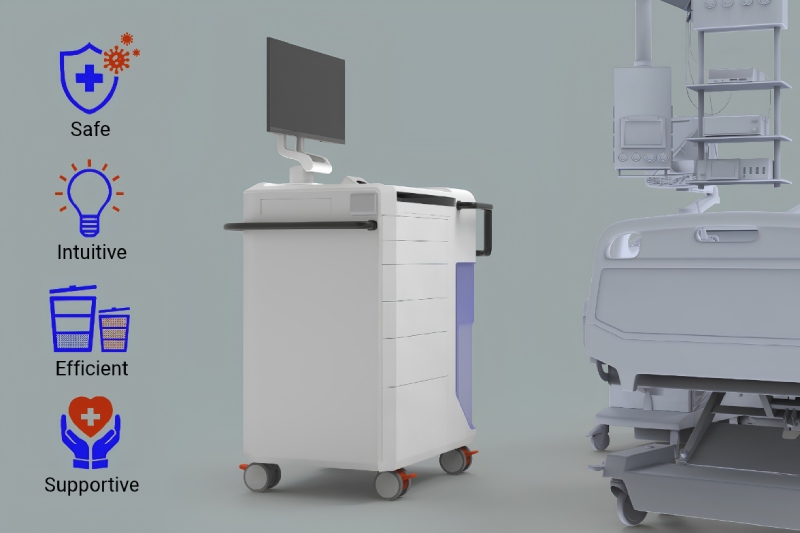
With his innovative Recurite design, Quinten Hensbergen won the Ecodesign Award in the Industrial Design category.
Sustainable product design: beyond materials
Recurite illustrates a key principle of Design for Sustainability: what matters isn't just the environmental impact of products themselves, but also how they are designed, used, and handled at the end of their useful life.
This goes beyond choosing sustainable materials. It also means designing for ease of use, safety, a long service life, and the preservation of product and material value. Recurite's modular structure also offers opportunities for adaptation, maintenance, and future improvements.
Separating waste streams at source creates better opportunities for high-quality recycling. But why stop there? A well-designed collection system can also lay the foundations for separately taking back products and components suitable for reuse, potentially after cleaning, sterilisation, or other forms of reprocessing. This shifts the focus from waste management to value retention: keeping usable products in circulation for longer and only recycling them when reuse is no longer feasible or appropriate.
Co-creation: involving healthcare professionals
The Recurite design process began with observations in three intensive care units, interviews, and discussions with nurses. Different concepts were tested using simple prototypes, augmented reality, and virtual reality. This allowed healthcare professionals to evaluate the designs in a realistic setting.
Hospital hygiene was also involved, as were other stakeholders. That input led, among other things, to the deliberate decision to keep hazardous medical waste outside the trolley. A good example of how sustainability, ergonomics, and medical safety can be brought together in a single design.
This co-creative and iterative approach is also a key pillar of D4SMD: developing sustainable solutions that are not only technically sound, but also fit into daily practice and gain user acceptance.
From smart design to environmental and economic benefits
How much environmental impact and cost can better waste sorting actually save? And how do these benefits compare with the production, maintenance, and service life of the medical trolley?
Simplified life cycle assessments (LCA) and techno-economic analyses (TEA) can be used to develop practical tools. These help identify the main environmental and cost drivers, compare design options, and support informed decisions.
Such an analysis would also be valuable for Recurite. It could examine the benefits of avoiding waste incineration, increasing recycling, and potentially reducing hospital costs. This would clarify the benefits the design can actually deliver and identify opportunities for further improvement.
Circular healthcare requires collaboration
Recurite demonstrates that sustainable innovation doesn't necessarily require complex technology. Smart product architecture, modularity, and intuitive operation can already make a significant difference. Digital design and simulation technologies can also help develop and test solutions faster and at lower cost.
However, Recurite's full potential extends beyond the medical trolley itself. Connecting it to collection systems, reverse logistics, reuse, reprocessing, and recycling requires collaboration between hospitals, manufacturers, logistics partners, and waste management companies.
This broader, system-wide approach is being taken forward through Ontzorg, a project by the University of Antwerp's REuseLab that investigates circular healthcare hubs.
D4SMD shares this ambition: accelerating the development of sustainable medical solutions through practical design methods, assessment tools, and collaboration across the value chain.
Conclusion
Recurite demonstrates how thoughtful product design makes healthcare more sustainable. Combining ease of use, waste sorting, and circularity creates solutions that fit into daily healthcare practice. The project also illustrates D4SMD's ambition: working with healthcare professionals and other partners to develop medical devices with a lower environmental impact.
Want to work together on more sustainable medical devices?
Would you like to integrate sustainability into your medical products from the design stage? Our experts offer knowledge in circular product design, practical methods, and collaboration. Discover how we can accelerate sustainable innovation in healthcare together.