With its new PBF-EB facility, Sirris is exploring the additive manufacturing of refractory metals
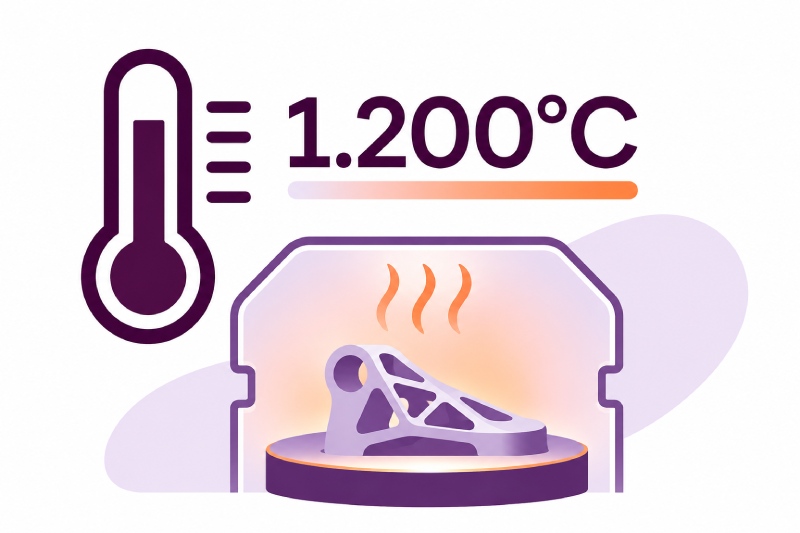
Metal additive manufacturing is opening up new industrial possibilities. However, some materials are still difficult to print because their high melting point or susceptibility to cracking makes processing them complicated. With its new PBF-EB facility, Sirris can investigate these materials at high temperatures. Its key advantages are preheating up to 1,200°C and a small production volume, enabling processes to be developed using smaller quantities of expensive metal powder.
New applications, new challenges for materials
The energy transition and electrification are driving increased interest in materials with specific thermal, electrical, magnetic, and mechanical properties.
But how can materials that are unsuitable for conventional manufacturing methods be processed?
Some have a very high melting point, while others are prone to cracking. Intermetallic materials and ceramics also offer possibilities for new applications. At the same time, it is becoming increasingly important to make efficient use of rare and strategic raw materials.
‘We’ve found that the materials of interest for new applications are often precisely those that are the hardest to process,’ explains Olivier Rigo, Additive Manufacturing Program Manager at Sirris. ‘With this facility, our aim is to broaden the process window and investigate how these materials can realistically be processed using additive manufacturing.’
PBF-EB: when electrons replace the laser
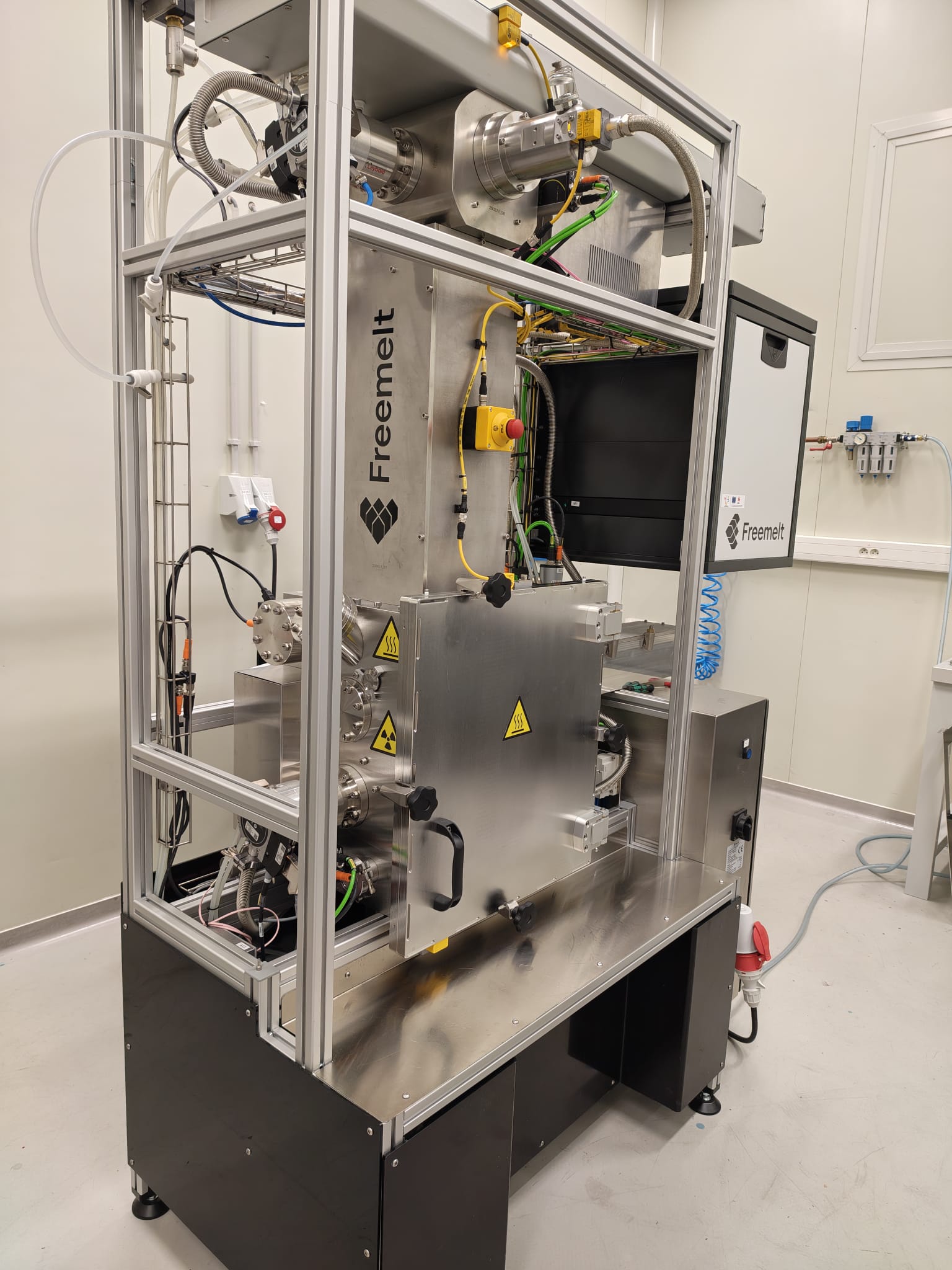
The new facility is based on powder bed fusion-electron beam (PBF-EB) technology.
As with other powder bed fusion technologies, the part is manufactured layer by layer from metal powder. With the PBF-EB process, however, an electron beam is used to melt the material.
The temperature range is a key difference. Sirris intends to use this technology to process materials at temperatures of over 1,000°C. This opens up new possibilities for materials that require high processing temperatures to produce high-quality components.
PBF-EB is not intended to replace laser powder bed fusion. Above all, it is an alternative processing method for materials that are difficult to work with at lower temperatures.
The machine has a number of technical features:
- A cylindrical build volume with a diameter of 100 mm and a height of 100 mm
- Can be extended up to 150 mm, according to current specifications
- Maximum advertised preheating temperature of 1,200°C, or even higher
- Layer thicknesses ranging from 150 to 500 µm
- Advertised accuracy of ±0.5 mm
Another key area of development concerns the reliability of the production process and quality control for the parts produced. In particular, Sirris will investigate the use of backscattered electrons (BSEs) to monitor process behaviour during manufacture, detect any deviations, and establish correlations with the final quality of the parts.
The aim is to improve the robustness of the process while assessing whether the need for non-destructive testing (NDT) after manufacture can be reduced.
A small production volume becomes an advantage
For a conventional production machine, a limited production volume may seem like a drawback. When it comes to materials development, it is a plus point.
The reason for this is that developing a new additive manufacturing process requires several experiments. The process parameters are adjusted, test specimens are produced, and the results are evaluated. When each test requires large quantities of expensive powder, the cost of the material alone can be a significant barrier.
The compact PBF-EB machine allows the initial stages of material and process development to be carried out using smaller quantities. A successful process can then be scaled up, particularly on the larger Arcam A2 machine available at Sirris.
This compact machine enables us to develop process parameters using smaller quantities of material. Once we have sufficiently mastered the process, we can move on to a larger production volume.
From tungsten to magnetic materials
Refractory metals are among the top development priorities. Sirris has specific plans to investigate four materials:
- Tungsten (W)
- Molybdenum (Mo)
- Niobium (Nb)
- Tantalum (Ta)
Sirris also wants to use the facility for magnetic materials and other functional materials, including FeSi and NdFeB.
FeSi6.5 may also be of interest for applications relating to energy conversion and electrification, such as transformers and electric motor rotors.
This line of enquiry builds on the expertise Sirris has already acquired in the additive manufacturing of Fe-Si6.5, a soft ferromagnetic alloy. Previous work has focused in particular on simulating the PBF-LB process to gain a better understanding of the thermal effects generated during manufacture and identify the process’s limitations in terms of cracking, particularly when the powder bed preheating temperature is limited to 200°C.
Sirris also has experience in electron beam technologies. In particular, research has been carried out on electron beam melting of Ti-6Al-4V, focusing on aspects such as microstructure, texture, mechanical properties, and surface finish.
In the medium term, the development programme also includes TiAl, a brittle intermetallic material. In the longer term, carbides such as WC are also being considered. These are research avenues, not materials for which validated production parameters are currently available.
From materials research to industry
The new facility’s uses extend beyond internal research programmes: it also aims to meet the practical needs of industrial companies.
Would you like to assess the suitability of a specific alloy for additive manufacturing?
There are several issues that need to be considered before planning production:
- Whether the material can be processed reliably
- What processing temperature needs to be reached
- Which parameters ensure high product quality
- What mechanical or functional properties can be achieved
This is where the compact machine needs to bridge the gap between materials research and industrial application. Companies can have a material and process investigated on a small scale, without having to invest immediately in production technology or use large quantities of expensive powder.
There is also a second factor to consider. The efficient use of rare and strategic raw materials is becoming increasingly important. Sirris’s analysis therefore highlights the importance of production processes that minimise material losses.
However, the PBF-EB process is not necessarily the most suitable or least expensive production method for every part. The economic viability of the process always depends on the material, the geometry, the required properties, post-processing, and the production volume. For materials that are difficult to work with and very expensive, however, the new facility opens up a further avenue for development.
Preheating to 1,200°C is therefore not the only innovative feature of this facility. The combination of high processing temperatures and a small production volume makes it possible to explore new material-process combinations using limited quantities of powder. If a combination proves successful, the next steps can be taken towards scaling up the process and applying it on an industrial scale.
Conclusion: a new area for industrial research
With its new PBF-EB facility, Sirris is expanding the possibilities for high-temperature additive manufacturing. Preheating to 1,200°C and a small production volume make it easier to explore challenging materials. A step-by-step approach can provide a better understanding of their behaviour and help prepare for future industrial applications.
Explore your materials with Sirris
Does your company work with refractory metals or materials that are difficult to process? Sirris’s experts can help you assess their potential in additive manufacturing.
Contact us to discuss your challenges and explore the possibilities of PBF-EB technology together.
Partners
Funding secured through the Wiiining (Very HightopEBM) project.