

FIBERWAL | Unlocking the value of secondary fibre-containing materials in Wallonia

Advanced sorting technologies for plastics and composites recycling
Plastics and composites containing glass fibres or mineral fillers are difficult to sort and recycle. To address this, FIBERWAL is developing a Walloon value chain to recover more value from these secondary materials. The project combines sorting technologies using multiple sensors, artificial intelligence, material characterisation and simulation to enable their use in new industrial applications.
Target group
FIBERWAL primarily targets:
- Recyclers and sorting companies handling complex plastic waste streams or plastics containing fillers
- Compounders and plastics and composites processors looking to incorporate more recycled materials
- Companies operating in the water, gas and wastewater infrastructure sectors
- Industries using sheet moulding compound (SMC) and bulk moulding compound (BMC) composites, particularly in the automotive and railway sectors
- Manufacturers of sorting equipment and technologies for complex waste streams
Context
Plastics and composites from complex waste streams remain difficult to recycle. This is particularly true for end-of-life vehicles, electrical and electronic equipment, and thermoset composites. The presence of glass fibres and mineral fillers makes these materials harder to identify and separate.
Conventional sorting technologies cannot always distinguish effectively between filled and unfilled polymers, particularly for black plastics. Variations in material composition also make it difficult to obtain homogeneous recycled fractions of sufficient quality.
As a result, materials with industrial potential often end up in lower-value applications or are discarded altogether. Better control over their composition, quality and traceability is needed to support their reuse in new products.
Objectives & results
FIBERWAL aims to establish a Walloon value chain that turns secondary fibre-containing materials from complex waste streams into valuable resources for new industrial applications.
The project aims to:
- Improve the identification and separationof plastics containing fibres or fillers
- Develop and characterise new recycled material fractions
- Adapt processing methods to the properties of these materials
- Validate their use in new industrial products
- Assess the technical, economic and environmental feasibility of new recycling value chains
The sorting system under development is designed to process approximately 2 tonnes of material per hour while maintaining high purity levels in each separated material fraction.
Key results:
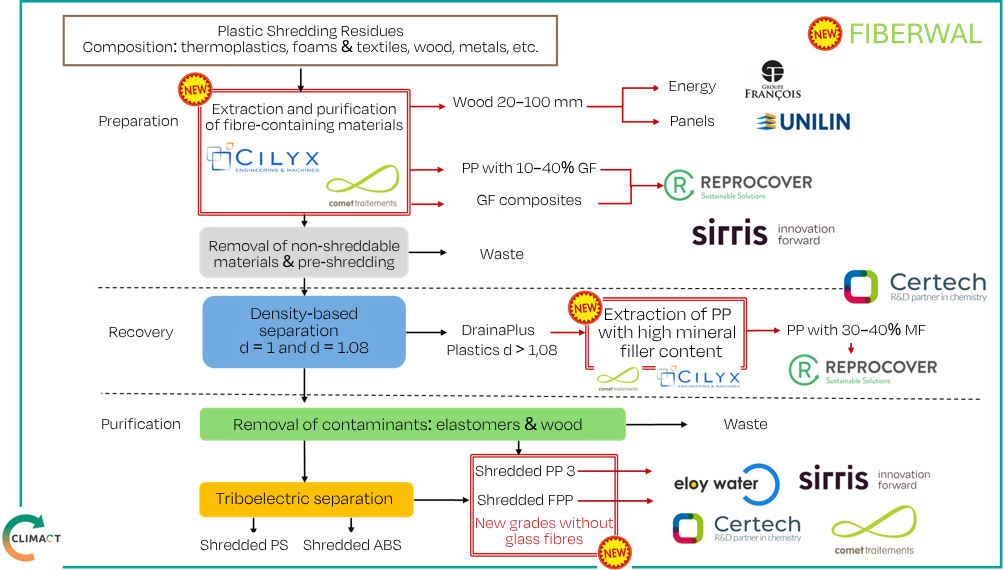
- A pre-industrial automated sorting demonstrator combining multiple detection technologies, artificial intelligence and pneumatic sorting
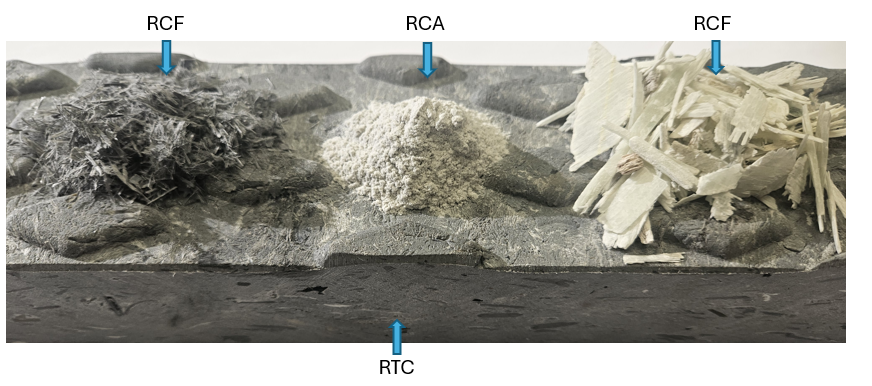
- New, characterised and traceable recycled fractions, including unfilled polypropylene (PP) and polymers containing fibres or mineral fillers
- Materials prepared for SMC/BMC composite applications, alongside a wood fraction suitable for further use
- Product demonstrators incorporating recycled materials, including a lightweight inspection cover and Oxybees® made from recycled PP
- A feasibility study for gratings made from PP reinforced with recycled fibres
- Design, simulation and optimisation methods adapted to recycled materials
- Recommendations linking material properties, processing parameters and product performance
- A life cycle assessment and an assessment of avoided CO₂ emissions
Approach
FIBERWAL covers the entire process, from selecting waste streams to integrating recycled materials into new products. The partners focus on four complementary areas.
- Identifying and separating materials
The partners first select the waste streams with the greatest potential. The project then develops a system combining multiple sensors, X-ray tomography, AI-based classification and high-speed pneumatic sorting. - Characterising and preparing recycled fractions
The recovered materials are processed and characterised to determine their properties and suitability for the targeted applications. - Developing and validating new products
The partners adapt material formulations, product designs, tooling and manufacturing processes to the recycled materials. The resulting solutions are then tested and validated at pre-industrial scale. - Assessing the viability of new value chains
The project analyses costs, competitiveness and associated business models. A life cycle assessment also examines environmental impacts and avoided emissions, alongside an assessment of socio-economic effects.
Looking to develop new applications for recycled plastics and composites?
Sirris' Product Development Hub supports companies in designing, prototyping and industrialising new products.
Funding
- Funding agency: SPW Recherche – Walloon Region, with the support of Pôle MecaTech
- Project type: Collaborative R&D project – Pôle MecaTech, AP47
- Contract number: Vestibulum a tincidunt orci
- Total budget: €5,020,236
- Funding level: €3,260,504
Logo of the project (unofficial)

Partners



More information about our expertise
Our experts

Do you have a question?
Send it to innovation@sirris.be